

The City of Murfreesboro continues the process to annex approximately 843 acres along Lebanon Pike and East Jefferson Pike, including the Middle Point Landfill property, currently owned by BFI Waste Systems of Tennessee, as well as land containing recreation fields and the Rutherford County Convenience Center.
If approved, the annexation would bring the property under city jurisdiction and is projected to generate around $39,000 annually in city tax revenue from BFI. City officials continue to review the plan, a part of broader efforts to manage growth and infrastructure in the area.
Below are letters, first from the legal counsel representing BFI Waste Systems of Tennessee, followed by the reply from Murfreesboro City Attorney Adam F. Tucker:
Adam Tucker
City Attorney
Kathy Jones, Chair
Murfreesboro Planning Commission
111 W. Vine Street
City Hall, 1st Floor
Murfreesboro, TN 37130
atucker@murfreesborotn.gov
Kathy@PeddlerInteriors.com
Re: Proposed Annexation of Middle Point Landfill Property
Dear Mr. Tucker and Ms. Jones,
Our firm represents BFI Waste Systems of Tennessee, LLC (“BFI”), the successor to Jefferson Pike Landfill, Inc. Our client has become aware of efforts being made to annex its property known as Middle Point Landfill into the City of Murfreesboro (the “City”). In fact, a plan of services for this proposed annexation has been circulated and may be considered by the Murfreesboro Planning Commission as soon as May 7, 2025.
Our client is not aware of any pending consents or request for annexation, which would authorize the City proceeding with annexation under T.C.A. § 6-51-104. Based upon our research, a written request was made to the City in 1995, as part of a contract for providing sewer service to the landfill. It appears the City of Murfreesboro either denied the request for annexation or did not act on the same. In either case, due to the age of any such request that may have been made, it has long since expired and is of no effect.
BFI is not contesting or objecting to annexation. However, in the absence of a request or consent from the affected landowner, BFI is unaware of a valid legal basis for the City’s current annexation activities without a referendum. We ask that the City meet its legal obligations to respect the rights of all landowners, and abandon the current unlawful annexation effort.
The City of Murfreesboro has made no attempt to communicate with our client as to this attempted annexation and the City of Murfreesboro has provided no basis as to its sudden interest in annexing Middle Point after decades of Middle Point’s operation. City officials have repeatedly disparaged our client but have made no efforts to further a productive discussion. Our client is a legally operating business, providing a valuable disposal service free of charge to the City of Murfreesboro (and thus the citizens of Murfreesboro) for their residential waste. In addition to the benefits provided by free disposal of the City’s residential waste, Middle Point also takes the City’s sewer sludge from its water treatment plant free of charge.
We hope the City will follow its statutory obligations with respect to annexation of Middle Point, and abandon the current unlawful procedure. As always, BFI remains amenable to discussion of its long-term relationship with the City.
Sincerely,
HOLLAND & KNIGHT
Edward M. Callaway
Jon Cooper
CC: Planning Commission Members (email only)
Murfreesboro City Council Members (email only)
1 To the extent the City of Murfreesboro is proceeding under the assumption that the 1995 request is still pending, this letter serves as a withdrawal of that request. Thus any attempt to annex Middle Point would be without the request or permission from the property owner.
2 In fact, at the February 19, 2025 Planning Commission meeting at which a study of this annexation was first discussed, Vice Chair Halliburton asked “This may not be a fair question and you may not want to answer it, but what’s the motive?” Jami Averwater, the Planning Commission member bringing the agenda item, stated “We don’t want to answer that.”
______

Edward M. Callaway and Jon Cooper
Holland & Knight
Nashville City Center
511 Union St., Suite 2700
Nashville, TN 37219
Re: Proposed Annexation of Middle Point Landfill Property
Dear Ed and Jon:
I have reviewed your letter of April 23, 2025, as well as the email you sent yesterday evening, regarding the City of Murfreesboro’s proposed annexation of Middle Point Landfill with City leadership. To begin with, it is deeply disappointing that you and your client, BFI Waste Systems of Tennessee, LLC (“BFI”), thought that the best way to approach the City about the proposed annexation was to send a demand letter rather than simply to pick up the phone and give me a call. The letter was clearly an attempt to intimidate the members of the City Council and Planning Commission, and given that the City is currently engaged in litigation with your client, I find your decision to copy them on the letter, rather than sending it simply to me, inappropriate at best.
Your letter once again demonstrates why the City and the residents of Rutherford County are hesitant to take your client or its parent corporation, Republic Services, Inc., at their word. It would appear from both your letter and your email that your client is attempting to evade its contractual commitments to the City. Indeed, for your client to assert that after 30 years of utilizing the City’s sanitary sewer service that its promises “not to oppose annexation” and “not to contest or object to annexation” do not constitute consent to annexation in exchange for that service and, if it did at one time constitute consent, for your client now to withdraw that consent is simply unconscionable.
In June 1995, as you and your client are well aware, the City of Murfreesboro and BFI’s predecessors-in-interest, Jefferson Pike Landfill, Inc. (“JPL”) and Browning-Ferris Industries of Tennessee, Inc., executed an agreement whereby the City agreed to provide sanitary sewer service to Middle Point Landfill and to accept the landfill’s pretreated leachate for further treatment at the City’s wastewater treatment plant despite the fact that at the time the landfill was located over a mile from Murfreesboro’s city limits.1 The fifth and sixth recitals of that agreement state:
WHEREAS, JPL has or will petition the City for annexation of the Middle Point Landfill Property; and
WHEREAS, JPL agrees that it will not oppose annexation of the Middle Point Landfill Property in the future should the City decline annexation at this time but choose to annex the Middle Point Landfill Property in the future.
Section 6 of the agreement, which is entitled “Annexation,” similarly states: “JPL, and its successors and assigns, agree that it will not contest or object to annexation of the Middle Point Landfill site by the City in the future, provided that such annexation does not in any manner prohibit, disrupt or in any manner interfere with the operation of the Middle Point Landfill.” On July 19, 1995, the Murfreesboro Planning Commission “recommend[ed] approval [of BFI] as an outside-the-city customer, with an agreement that they will not oppose any future annexation.” The City was under no obligation to provide sewer service to Middle Point Landfill, and BFI’s promise not to oppose, contest, or object to annexation was part of the consideration for providing such service.
It is the City’s position that BFI’s promises in a written agreement “not to oppose” and “not to contest or object” constitute consent. If anything, the words in the agreement are more explicit forms of consent. Consent is defined as “a voluntary yielding to what another proposes or desires.” CONSENT, Black’s Law Dictionary (12th ed. 2024). There is no reasonable argument that BFI’s promises “not to oppose” and “not to contest or object” do not constitute the voluntary yielding to what another proposes. Whether the language used is in the affirmative (“consent”) or in the negative (“not object,” “not contest,” or “not oppose”) the legal implications are the same. Indeed, any other interpretation of the agreement’s language would render the language meaningless.
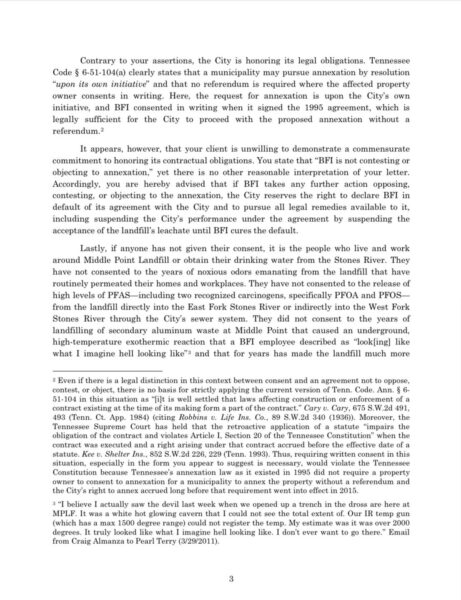
Contrary to your assertions, the City is honoring its legal obligations. Tennessee Code § 6-51-104(a) clearly states that a municipality may pursue annexation by resolution “upon its own initiative” and that no referendum is required where the affected property owner consents in writing. Here, the request for annexation is upon the City’s own initiative, and BFI consented in writing when it signed the 1995 agreement, which is legally sufficient for the City to proceed with the proposed annexation without a referendum.2
It appears, however, that your client is unwilling to demonstrate a commensurate commitment to honoring its contractual obligations. You state that “BFI is not contesting or objecting to annexation,” yet there is no other reasonable interpretation of your letter. Accordingly, you are hereby advised that if BFI takes any further action opposing, contesting, or objecting to the annexation, the City reserves the right to declare BFI in default of its agreement with the City and to pursue all legal remedies available to it, including suspending the City’s performance under the agreement by suspending the acceptance of the landfill’s leachate until BFI cures the default.
Lastly, if anyone has not given their consent, it is the people who live and work around Middle Point Landfill or obtain their drinking water from the Stones River. They have not consented to the years of noxious odors emanating from the landfill that have routinely permeated their homes and workplaces. They have not consented to the release of high levels of PFAS—including two recognized carcinogens, specifically PFOA and PFOS—from the landfill directly into the East Fork Stones River or indirectly into the West Fork Stones River through the City’s sewer system. They did not consent to the years of landfilling of secondary aluminum waste at Middle Point that caused an underground, high-temperature exothermic reaction that a BFI employee described as “look[ing] like what I imagine hell looking like” and that for years has made the landfill much more difficult to manage. You claim that City officials have repeatedly disparaged your client; however, you know as well as I that the City’s factual statements do not constitute disparagement. For over a year, the City has engaged in productive discussions with your client in an attempt to resolve the numerous environmental and nuisance issues with Middle Point’s operation. It is your client’s statements and actions that are now threatening that cooperation.
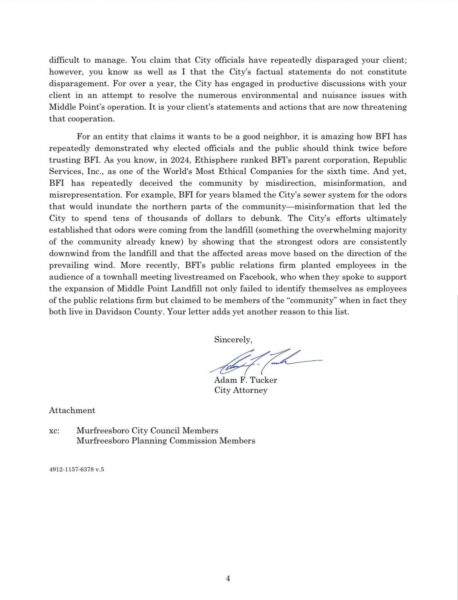
For an entity that claims it wants to be a good neighbor, it is amazing how BFI has repeatedly demonstrated why elected officials and the public should think twice before trusting BFI. As you know, in 2024, Ethisphere ranked BFI’s parent corporation, Republic Services, Inc., as one of the World’s Most Ethical Companies for the sixth time. And yet, BFI has repeatedly deceived the community by misdirection, misinformation, and misrepresentation. For example, BFI for years blamed the City’s sewer system for the odors that would inundate the northern parts of the community—misinformation that led the City to spend tens of thousands of dollars to debunk. The City’s efforts ultimately established that odors were coming from the landfill (something the overwhelming majority of the community already knew) by showing that the strongest odors are consistently downwind from the landfill and that the affected areas move based on the direction of the prevailing wind. More recently, BFI’s public relations firm planted employees in the audience of a town hall meeting livestreamed on Facebook, who when they spoke to support the expansion of Middle Point Landfill not only failed to identify themselves as employees of the public relations firm but claimed to be members of the “community” when in fact they both live in Davidson County. Your letter adds yet another reason to this list.
Sincerely,
Adam F. Tucker
Murfreesboro City Attorney
1 In your email, you inquire about the City’s “goals and plans for annexation,” and while the City’s reasons for pursuing annexation at this time have no bearing on the City’s right to annex the property, I refer you to the statements of Mayor McFarland and others at Murfreesboro City Council’s February 13, 2025 meeting. (The minutes and video of that meeting are available to the public at https://www.murfreesborotn.gov/agendacenter.) In short, the primary reason for annexing the landfill is that unlike 30 years ago, the landfill is now adjacent to the City and in close proximity to residential neighborhoods, commercial establishments, and City recreational facilities. The landfill’s operations, therefore, have a much greater impact on the City and its residents than they did 30 years ago. While annexation will add the property to the City’s tax roll and bring the property within the scope of the City’s stormwater management ordinance (Murfreesboro City Code Chapter 27.5, https://library.municode.com/tn/murfreesboro/codes/code of ordinances), the City does not anticipate either change will in any way interfere with the operation of the landfill nor would either affect any other matters the City and BFI have discussed in mediation. For further information about the proposed annexation, please see the Plan of Services that accompanies this letter.
2 Even if there is a legal distinction in this context between consent and an agreement not to oppose, contest, or object, there is no basis for strictly applying the current version of Tenn. Code. Ann. § 6- 51-104 in this situation as “[i]t is well settled that laws affecting construction or enforcement of a contract existing at the time of its making form a part of the contract.” Cary v. Cary, 675 S.W.2d 491, 493 (Tenn. Ct. App. 1984) (citing Robbins v. Life Ins. Co., 89 S.W.2d 340 (1936)). Moreover, the Tennessee Supreme Court has held that the retroactive application of a statute “impairs the obligation of the contract and violates Article I, Section 20 of the Tennessee Constitution” when the contract was executed and a right arising under that contract accrued before the effective date of a statute. Kee v. Shelter Ins., 852 S.W.2d 226, 229 (Tenn. 1993). Thus, requiring written consent in this situation, especially in the form you appear to suggest is necessary, would violate the Tennessee Constitution because Tennessee’s annexation law as it existed in 1995 did not require a property owner to consent to annexation for a municipality to annex the property without a referendum and the City’s right to annex accrued long before that requirement went into effect in 2015.
3 “I believe I actually saw the devil last week when we opened up a trench in the dross are here at MPLF. It was a white hot glowing cavern that I could not see the total extent of. Our IR temp gun (which has a max 1,500 degree range) could not register the temp. My estimate was it was over 2000 degrees. It truly looked like what I imagine hell looking like. I don’t ever want to go there.” Email from Craig Almanza to Pearl Terry (3/29/2011).