

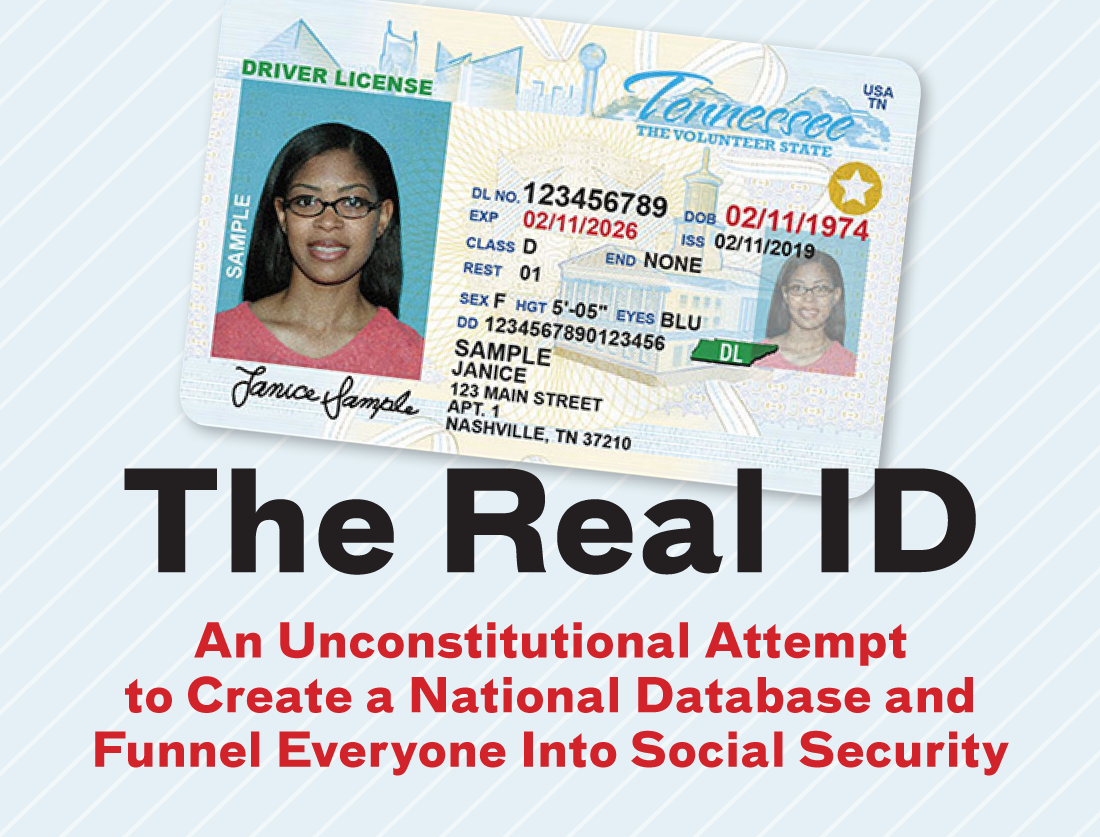
It took more than 20 years, but the REAL ID Act of 2005 is finally being enforced. While several people have talked about the requirements for a REAL ID, and whether or not they even need one, I haven’t heard anyone ask one very important question: Is it legal?
History
After the attacks on Sept. 11, 2001, politicians scrambled to find ways to claim they were protecting the American people. The Patriot Act, the Transportation Security Administration, and the resulting explosion of surveillance cameras are just a few examples. In the middle of this maelstrom of security came “the REAL ID Act of 2005.” What was the purpose of this legislation?
To establish and rapidly implement regulations for state driver’s license and identification document security standards, to prevent terrorists from abusing the asylum laws of the United States, to unify terrorism-related grounds for inadmissibility and removal, and to ensure expeditious construction of the San Diego border fence.
— The REAL ID Act of 2005
If there’s one thing I’ve learned about reading legislation, it’s this: Don’t believe the title. Yes, this is the REAL ID Act, and yes, it does claim to create standards for REAL IDs, but that’s not all it does. As a matter of fact, less than 20% of the words in this legislation have anything to do with REAL IDs. Most of the language deals with terrorists and immigration.
The logic behind the REAL ID portion of this legislation is to ensure that those who’ve been issued these “enhanced” identifications really are the people they claim to be, supposedly to enhance security for air travel and access to federal and military locations.
This act places no requirement for a state to recognize a REAL ID, it simply defines the requirements for a state-issued ID to be recognized by the federal government. However, even with this simple goal, things did not work out as planned.
Beginning 3 years after the date of the enactment of this Act, a Federal agency may not accept, for any official purpose, a driver’s license or identification card issued by a State to any person unless the State is meeting the requirements of this section.
— The REAL ID Act of 2005
Even though the requirement for federal agencies to accept only REAL IDs became active three years after the enactment of this legislation, it took 20 years to get everything in place.
Part of the reason for the delay were the requirements for a state-issued ID to meet these new standards. Most of the standards are pretty simple: full name, date of birth, address, etc. However, a couple of requirements made things difficult.
(8) Physical security features designed to prevent tampering, counterfeiting, or duplication of the document for fraudulent purposes.
(9) A common machine-readable technology, with defined minimum data elements.
— The REAL ID Act of 2005
Remember, there are 50 states plus the District of Columbia, not to mention territories like Puerto Rico and Guam, that had to both agree to and adopt these standards. What security features would the states implement? Could all of the states produce IDs with those features, or would they have to buy new equipment? Did all of the states have data systems to collect and process the minimum data elements? And who would decide which security features and data elements would be required?
Federal Overreach
It seems Congress can hardly pass legislation without going beyond the powers vested in them by the Constitution. Take, for example, this demand of the legislation.
The Minimum Issuance Standards of The REAL ID Act state that a “State shall require presentation and verification of certain information before issuing a driver’s license or identification card to a person.”
However, nothing in the Constitution of the United States delegates to its government the power to regulate driver’s licenses or identification. Congress can determine the rules for identifications that federal agencies are allowed to accept, but they cannot dictate to the states what their IDs must include. While technically the states are only required to meet these standards if they want the federal government to recognize them, as with voter registration, it will be difficult for states to create a two-tiered identification system. That is not the only overreach in this section:
(C) Proof of the person’s social security account number or verification that the person is not eligible for a social security account number.
— The REAL ID Act of 2005
What does participation in the illegal government retirement program, Social Security, have to do with your identification? How does a Social Security number verify who you are, especially since these documents do not include a photo or other information used for identification purposes? Could this be another attempt to make sure everyone participates in this illegal Social Security program?
Then there are the “special requirements,” some of which will make things quite difficult for some people, such as requiring—before issuing a driver’s license or identification card—valid documentary evidence that the person is either a citizen of the United States or is an alien lawfully admitted for permanent or temporary residence in the United States.
My first thought is that this will make things more difficult for “sanctuary” cities and states. After all, they won’t be able to go 100% to REAL IDs since illegal aliens are not eligible for them. What if an illegal alien needs to enter a federal courthouse, possibly to turn themselves in or appear for a hearing? They will be required to have a REAL ID to enter. So how could they comply with a federal order to appear if courthouse security won’t let them in?
Additionally, under the act, a state shall verify the issuance, validity and completeness of each document required to be presented by the person applying for an ID.
And who verifies that the documents were verified? What if those documents were issued by entities that don’t share information? For example, states can accept official foreign passports for identification, but how do states verify those passports?
Expanding the Police State
As if the examples of the federal government becoming a police state aren’t numerous enough, this REAL ID expands them further.
To meet the requirements of this section, a State shall adopt the following practices in the issuance of drivers’ licenses and identification cards:
(1) Employ technology to capture digital images of identity source documents so that the images can be retained in electronic storage in a transferable format.
(2) Retain paper copies of source documents for a minimum of 7 years or images of source documents presented for a minimum of 10 years.
(3) Subject each person applying for a driver’s license or identification card to mandatory facial image capture.
— The REAL ID Act of 2005
More instances of governments trying to capture images of you to search later. I’ve talked before about automated license plate readers; now the government wants a copy of your driver’s license photo, and they want it in a database. As if that weren’t bad enough, the federal government will bribe the states into sharing this data. In order to be eligible to receive any grant or other type of financial assistance made available under the REAL ID Act, a state shall participate in the interstate compact regarding sharing of driver license data, a database known as the Driver License Agreement.
How is the federal government going to get the states to join in this database? With bribery, of course.
More Federal Bribery
Since this legislation has put requirements on the states that will cost them money if they wish their IDs to be federally recognized, Congress can’t seem to resist waving a bribe before them—federal grants to a state to assist it in conforming to the standards set forth in the law.
The Secretary of Homeland Security is authorized to bribe the states with grants not authorized by the Constitution of the United States.
Conclusion
Now, after 20 years of trying, this legislation is finally going into effect. While I recognize the need for identification to be trustworthy, I don’t think Congress should be allowed to violate the Constitution to do so.
One of the obvious purposes of this so-called REAL ID appears to be to make sure everyone has their illegal Social Security number. I’m still baffled by why the federal government wants to link their illegal retirement system to your photo ID? Could it be an attempt to create a national ID system? Congress has tried in the past to create a national ID, and failed. By placing any financial assistance to the states to their participation in an interstate compact to share data, Congress has effectively created a national ID database, including not only your name and birth date, but a facial recognition image. And this data is linked to your state ID, which includes copies of the documents you used to prove your identity—in other words, everything law enforcement needs to find you if they want. This would be scary enough if Congress and the courts required law enforcement to follow the Fourth Amendment, but in general they haven’t.
Does the federal government have the authority to determine the requirements for the identification documents they accept? Yes. Can Congress limit access to federal buildings to those with proper ID? Generally, yes, but I do see some problems with the limitations they’ve put into place. Does the federal government have the right to limit air travel to those with these documents? I see nothing in the Constitution that would grant to them that power.
After asking about the constitutionality of The REAL ID Act, the next most common question is: Do I need one? Ultimately, it’s up to you. When I lived in New York State, I got an enhanced driver’s license to allow me to drive across the Canadian border without other documentation. That was my decision, which I made for my convenience. While many “news” outlets imply that people will need a REAL ID to fly or enter a federal building, that is not true. There are other federally recognized IDs, like a passport, which will work just fine for these purposes. So the answer to the question, “Do you need a REAL ID?” ultimately comes down to your convenience versus your concerns about a federal ID database. If you have no immediate need to fly or enter a federal building, you can put off this decision until you renew your driver’s license.
Will Congress one day try to force the states to only issue REAL ID driver’s licenses? While unconstitutional, illegal, and void, it would not surprise me one bit. And if you’re hoping the courts would prevent such unconstitutional legislation, recent history shows that would be unlikely.