

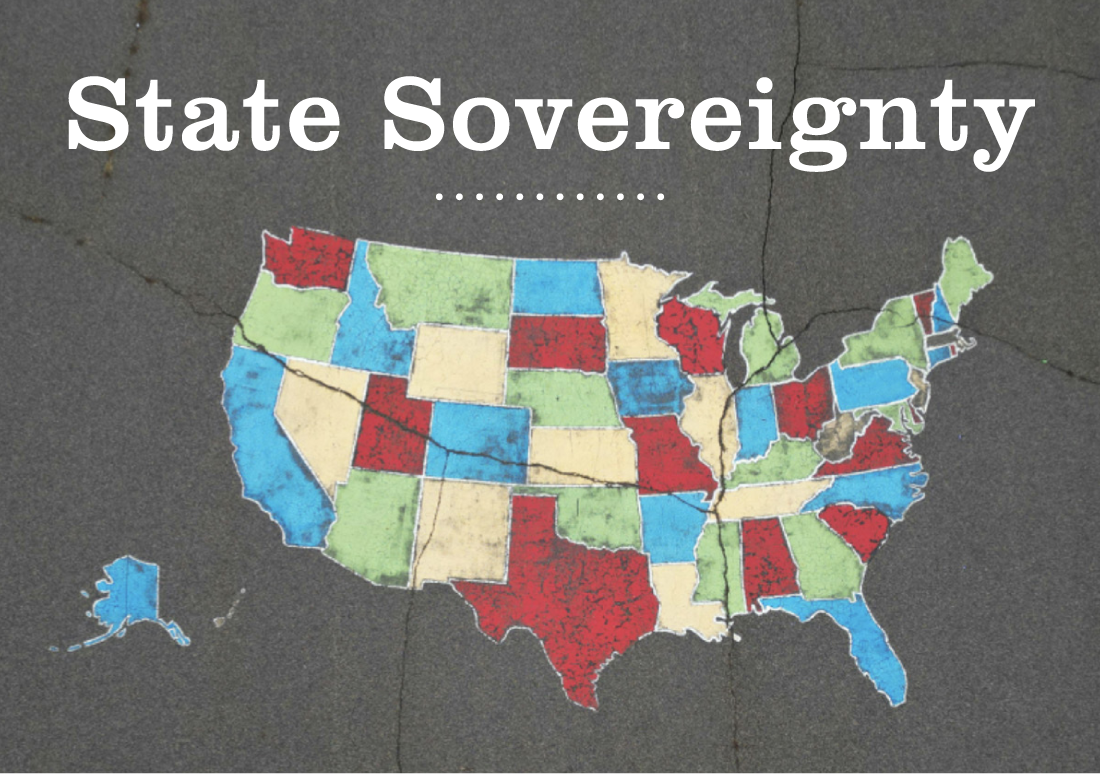
Which came first, the states or the federal government? Who created whom? Did the federal government create the states? No, the states created the federal government when they ratified the Constitution. So, if the states are the “parents” of the federal government, why are they not sovereign over it? One state legislature tried to pass legislation to reassert their position as sovereign over the federal government. Sadly, that measure did not pass . . . yet.
Sovereignty
The Texas Legislature attempted to pass a bill some have called the Texas Sovereignty Act. The stated purpose of the bill was:
AN ACT
relating to the authority of the legislature to determine that certain federal directives are unconstitutional and to prohibit certain government officers and employees from enforcing or assisting in the enforcement of the directive.
— Texas H.B. No. 796
Texas was not the first state to consider such legislation, and I can only hope it won’t be the last. This time the bill died in the Senate. However, I still think it’s worth looking at both in the hopes that the Texas legislature will pick this up again in the future, and that other states will be inspired to do so as well.
To understand this legislation, we need a bit of a history lesson on the United States of America.
History
Way back in 1776, the 13 colonies declared themselves free and independent states.
We, therefore, the Representatives of the united States of America, in General Congress, Assembled, appealing to the Supreme Judge of the world for the rectitude of our intentions, do, in the Name, and by Authority of the good People of these Colonies, solemnly publish and declare, That these United Colonies are, and of Right ought to be Free and Independent States; that they are Absolved from all Allegiance to the British Crown, and that all political connection between them and the State of Great Britain, is and ought to be totally dissolved; and that as Free and Independent States, they have full Power to levy War, conclude Peace, contract Alliances, establish Commerce, and to do all other Acts and Things which Independent States may of right do.
— Declaration of Independence
These brand-new and independent states recognized that they would need to work together if they were to survive, especially against their mother country, Great Britain. Congress proposed the Articles of Confederation in November of 1777, and it was ratified by the new states in March of 1781. Within this document, the states adopted a name for their new creation:
The Stile of this confederacy shall be, “The United States of America.”
— Articles of Confederation, Article I
The Articles of Confederation did not last long and was replaced in 1787 with the Constitution for the United States of America, which only went into effect after the states ratified it.
This means that the Constitution is an interstate compact—an agreement among states or between nations on matters in which they have a common concern.
This also means that the states are parties to the compact. And since the federal government is a creation of this compact, the states not only created the federal government, but delegated to it limited and enumerated powers.
The powers not delegated to the United States by the Constitution, nor prohibited by it to the States, are reserved to the States respectively, or to the people.
— U.S. Constitution, Amendment X
Supremacy Clause
So, if the states created the federal government, if the states are the only entities that can delegate powers to this government, why do so many state governments act as subjects of the federal government rather than its master? From my research, I find two reasons for this power inversion.
First, it’s a misinterpretation of the Supremacy Clause.
This Constitution, and the Laws of the United States which shall be made in Pursuance thereof; and all Treaties made, or which shall be made, under the Authority of the United States, shall be the supreme Law of the Land; and the Judges in every State shall be bound thereby, any Thing in the Constitution or Laws of any State to the Contrary notwithstanding.
— U.S. Constitution, Article VI, Clause 2
Law schools teach, and it’s widely accepted, that the Supreme Court is the supreme law of the land. They may not use those words, but that’s the impact of their teachings. However, a quick look at the supremacy clause shows that court decisions hold no position in the supreme law of the land. In fact, the judges in every state are bound to the supreme law, not the Supreme Court.
It’s also taught and accepted that any act of Congress signed by the President supersedes state law. Once again, a quick look at the supremacy clause shows that only “Laws of the United States which shall be made in Pursuance” of the Constitution are the supreme law of the land.
Second is the fact that, based on my research, the Constitution is no longer taught in our law schools. This indoctrination of our entire legal system has led the idea that the states are subdivisions of the federal government, not its creator and master. If attorneys had studied the Tenth Amendment and the Necessary and Proper Clause, then maybe the need for states to reassert their sovereignty would not be necessary.
This is where the Texas Sovereignty Act, and others like it, come into play. This would not be the first time that states declared the acts of the federal government unconstitutional. The most famous of these happened back in 1798 with the Virginia and Kentucky Resolutions.
That the good people of this Commonwealth having ever felt and continuing to feel the most sincere affection for their brethren of the other states, the truest anxiety for establishing and perpetuating the union of all, and the most scrupulous fidelity to that Constitution which is the pledge of mutual friendship, and the instrument of mutual happiness, the General Assembly doth solemnly appeal to the like dispositions of the other States, in confidence that they will concur with this Commonwealth in declaring, as it does hereby declare, that the acts aforesaid are unconstitutional, and that the necessary and proper measures will be taken by each, for cooperating with this State in maintaining unimpaired the authorities, rights, and liberties, reserved to the States respectively, or to the people.
— Virginia Resolution
In more recent years, many states have also considered similar legislation, while others simply ignore federal laws like those involving the use of marijuana or assisting the federal government in enforcing their immigration laws.
A move of this importance should not be left to whimsical decision-making processes. The Texas legislature proposed a robust structured process for declaring a federal act unconstitutional, one that would have given the legislature the ability, by concurrent resolution, to (1) determine that a federal directive is an unconstitutional federal directive; and (2) prohibit a government officer or employee from enforcing or assisting in the enforcement of the unconstitutional federal directive.
The Texas legislature also recognized the constitutional authority of the federal government to call up the state’s militia.
(b) This section does not apply to a federal directive that activates the state military forces as defined by Section 431.001.
— TX H.B. No. 796
This act would have also required the legislature to be specific about which federal acts were unconstitutional, and their impact on state officers and employees. A concurring resolution designating “an unconstitutional federal directive” would have required a two-thirds majority for passage. Such a resolution could be repealed, but only by a two-thirds majority.
Overall, this appears to be a reasonable and logical way for a state to reassert both its sovereignty and power as a party to the Constitution to oversee their creation.
Conclusion
Sadly, this bill did not pass the Texas Senate. I’m not sure why, but I can take some reasonable guesses. It appears that more state legislatures are controlled by attorneys—not just those members who have gone to law school, but it is my understanding that any proposed legislation is frequently passed by attorneys for their opinions before it is debated. Since it is probable that the attorneys who are reviewing this legislation haven’t actually studied the supreme law of the land, I can see where their opinions about legislation would deviate from what the Constitution actually says. It’s also possible that state legislators simply don’t want to pick a fight with the federal government.
Regardless of why, this bill failed. As we’ve all heard, “If at first you don’t succeed, try, try again.” I would suggest that not only to the legislators and citizens in Texas, but in all 50 states. Because if you want to understand why the federal government is out of control, regulating just about every aspect of our lives, the answer is because the states didn’t stand up when the feds went too far. If you want to know why the federal government has a $37 trillion deficit, it’s because the states didn’t stand up when the feds embezzled money from its citizens.
Whether you are in Texas or another state, it’s time we take legislation like the Texas Sovereignty Act and get our representatives to push it through. It is the only legal way to rein in an out-of-control federal government. I’m not saying the feds will meekly submit; in fact I expect them to fight tooth and nail to maintain their illegal ways. This is why we need people of character to hire representatives of character, at both the state and federal level, to follow the supreme law of the land. That is the only way to restore the rule of law to this great nation.
___
Photo, top, courtesy of Blake / Pexels