

It is that time of year again when a whole new batch of kiddos are off to school (or a school-like environment) for the first time. For many of these children, it will be the first time they are without their parents or guardians. Even more importantly, it will be the first time they are experiencing what it is like to interact with other children for extended periods. This. Can. Be. Daunting.
Worry not, parents—we have all the answers right here! (Spoiler alert: we don’t actually have all the answers.)
Regardless, let’s plow ahead and get into it!
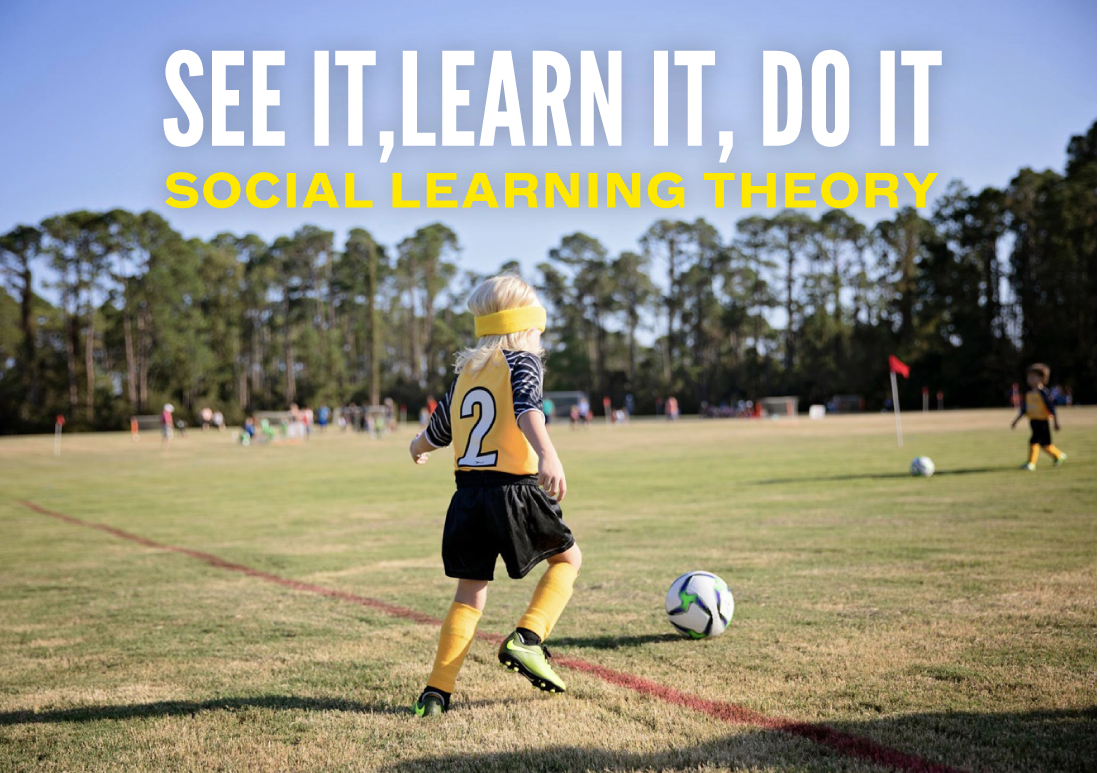
Psychologist Albert Bandura came up with social learning theory, which explains that we don’t just learn by doing things ourselves—we also learn by watching other people. We pay attention to what others do, notice what happens to them and, sometimes, copy their behavior. Things like attention, motivation, emotions and personal attitudes all affect how much we actually learn via this method.
Unlike previous ideas that stated our learned behaviors only happen through direct experience (like direct personal rewards or punishments), Bandura showed that we can also learn just by observing others.
For example, if you’ve never kicked a soccer ball before, you’d probably still know how to try—just from watching others do it. That’s social learning in action.
There are three key ideas that comprise this type of learning.
1. We can learn by observing: We don’t always need to try something ourselves to understand it. Watching, listening or even reading about an action can teach us.
2. Our thoughts and feelings matter: Learning isn’t just about outside rewards or punishments. Internal experiences—like pride, satisfaction or feeling accomplished—also motivate us. Bandura called this intrinsic reinforcement.
3. Learning doesn’t always mean immediate change: Just because someone learns something doesn’t mean they’ll act on it right away. For example, you may know how to solve a problem but choose not to show it unless needed.
How We Learn Through Observation
● Attention: You have to notice what’s going on. If you’re distracted, you won’t learn much.
● Retention: You need to remember what you saw.
● Reproduction: You try the behavior yourself. Practice makes you better.
● Motivation: You’ll be more likely to copy the behavior if you’re motivated—especially if you see others being rewarded for it.
We incorporate all four of these essential elements into our curriculum for all Lil’ Kickers’ classes. Creative game play combined with easily repeatable steps allow for memory development and, ultimately, success and confidence.
Social learning theory shows us that life would be much harder if we had to learn everything on our own. Instead, we shortcut the process by watching others. Whether good or bad, what our children see around them will, ultimately, shape how they think and act as they continue to grow. As parents, my wife and I fully understand we are not able to control everything our child observes at school. We do try to place him in other extracurricular environments that we believe and hope will provide the types of visual stimulation and cues that align with the positive intrinsic reinforcement that will, ultimately, serve him throughout the maturation process.
Remember, parents—strength in numbers. As parents, we’ve got this! We are all our best resources, so please share your own thoughts or questions by dropping us an email. We’d love to hear from you and we’ll be sure to address the topics here for the benefit of the community. Contact me with any questions or suggestions at thepulse@thelkm.com.