
Part 1 of an ongoing series on data centers, energy, and the AI build-out in Middle Tennessee
Last month at a local bank, I overheard a story about the San Francisco 49ers investigating a viral rumor: Was an electrical substation near their practice facility causing player injuries? People were worried, but tests later suggested exposure well below any danger level.
I bring this up because data centers will soon challenge us, as a community, to separate fear from fact. Our situation, though, is unique: while the 49ers could have possibly removed the substation, we may not be able to choose to remove data centers once they are implemented. These facilities are arriving across Tennessee, driven by massive AI investment, whether we like it or not.
The issue, then, is not if data centers are coming, but under what conditions. Jon Hoscheit, the Chief Technical Officer for Data Suites Murfreesboro, a local data center, and chair of the Murfreesboro Technology Council, told me in 2024 that AI would drive the next wave and that local data centers would be the delivery point.
He was right.
In an article published earlier in 2026, Hoscheit describes Data Suites as serving customers since 2016 and operating with 50 kilowatts or more of power per rack. To translate that out of industry shorthand: a data center is organized into “racks,” metal frames about the size of a refrigerator that hold many servers. The electricity a rack uses tells you what kind of work it can do. A rack handling an email and file storage system might use 5 to 10 kilowatts. A rack running AI can use 50 kilowatts or more, roughly the continuous demand of 40 average homes, through a single cabinet. Data Suites is now in that AI-capable tier, built for the kind of intense computing behind modern AI rather than just the storage most people picture when they hear “data center.”
Not all data centers are the same.
This is where understanding the terms becomes essential, and where most national coverage blurs distinctions. The headlines usually focus on one type of facility: “hyperscale” campuses in places like Northern Virginia, Phoenix and Dallas. These hyperscale data centers are massive complexes owned by a single company, using as much power as a small city, enough to power 100,000 homes, and consuming hundreds of millions of gallons of water each year. In contrast, “edge” data centers, like those being built closer to where people live, support AI computing that benefits from proximity. When you ask an AI agent a question, the answer travels from your phone to a data center and back; the farther away the data center is, the longer it takes. For applications that need instant responses, edge centers, which are smaller and more numerous, are more effective.
Hoscheit argues that this edge model will become a bigger part of the build-out than headlines suggest, and that Middle Tennessee is well positioned for it.
“Edge colocation isn’t a compromise,” he writes. “It’s the right architecture for most of what AI is going to do over the next decade.”
A small edge facility with modern cooling and reasonable power use is very different from a hyperscale campus, which demands enormous power and water resources and is often built in regions already facing water shortages. Simply hearing that “a data center is coming to town” doesn’t reveal much until we know what type it is, how much power it will consume, and how it is cooled.
Northern Virginia could not stop the data center boom either, but the backlash there changed the rules for where centers can be built, creating new protections for people who pay the electric bills. Tennessee passed its own law in April, signed by Governor Lee on May 7, requiring large data centers to pay for their own infrastructure instead of passing the cost to current ratepayers. The debate was never just about saying yes or no. It was about the details: who pays, what information is shared, how the centers are cooled, and what happens if an operator violates the rules.
That’s what this series will dig into over the coming months: the variables worth spending our energy on. How data centers use water, which depends almost entirely on the cooling system. What our power grid is facing as demand climbs. What the troubled xAI project in Memphis shows about an operator left unaccountable. How to read an environmental claim when the operator says one thing and the evidence says another, something Murfreesboro knows more about than most. And finally, the practical questions worth asking when a developer files plans. The expansion of data centers has already been decided, but the details have not. That is where we should focus our attention.
Next month, Part 2: The Water Question. We will look at what “data center water use” really means and why one technical decision can make the difference between a facility that uses a lot of water and one that hardly uses any.
___
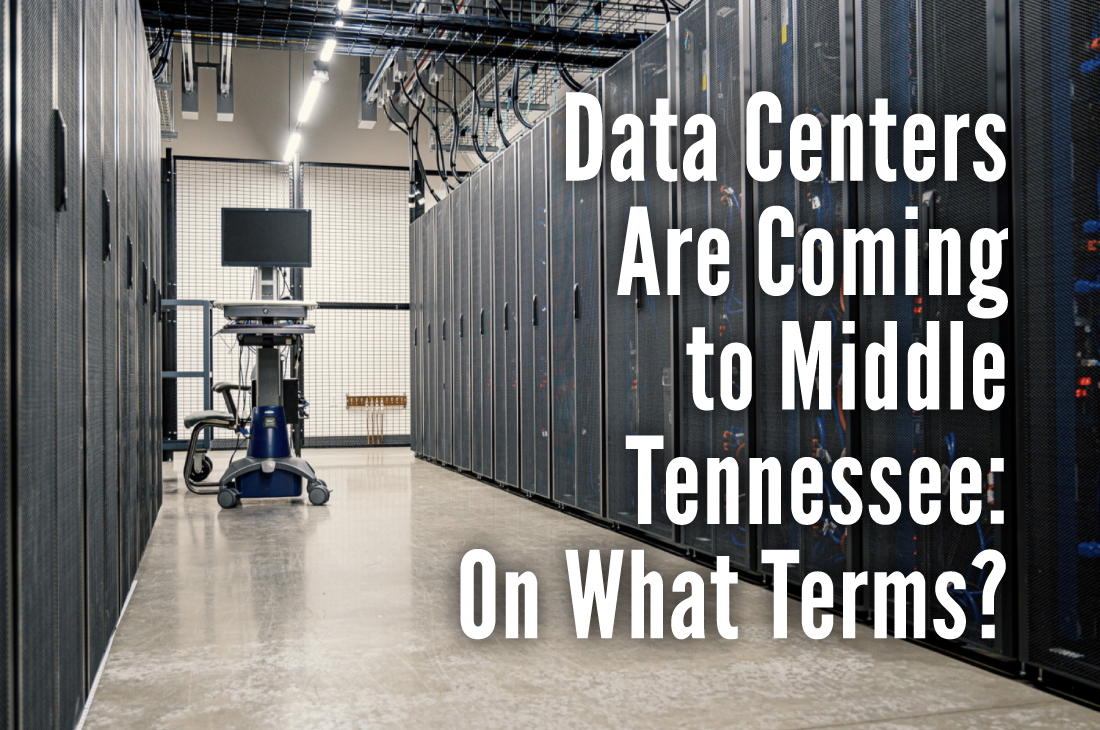
Photo, top, courtesy of Brett Sayles / Pexels