

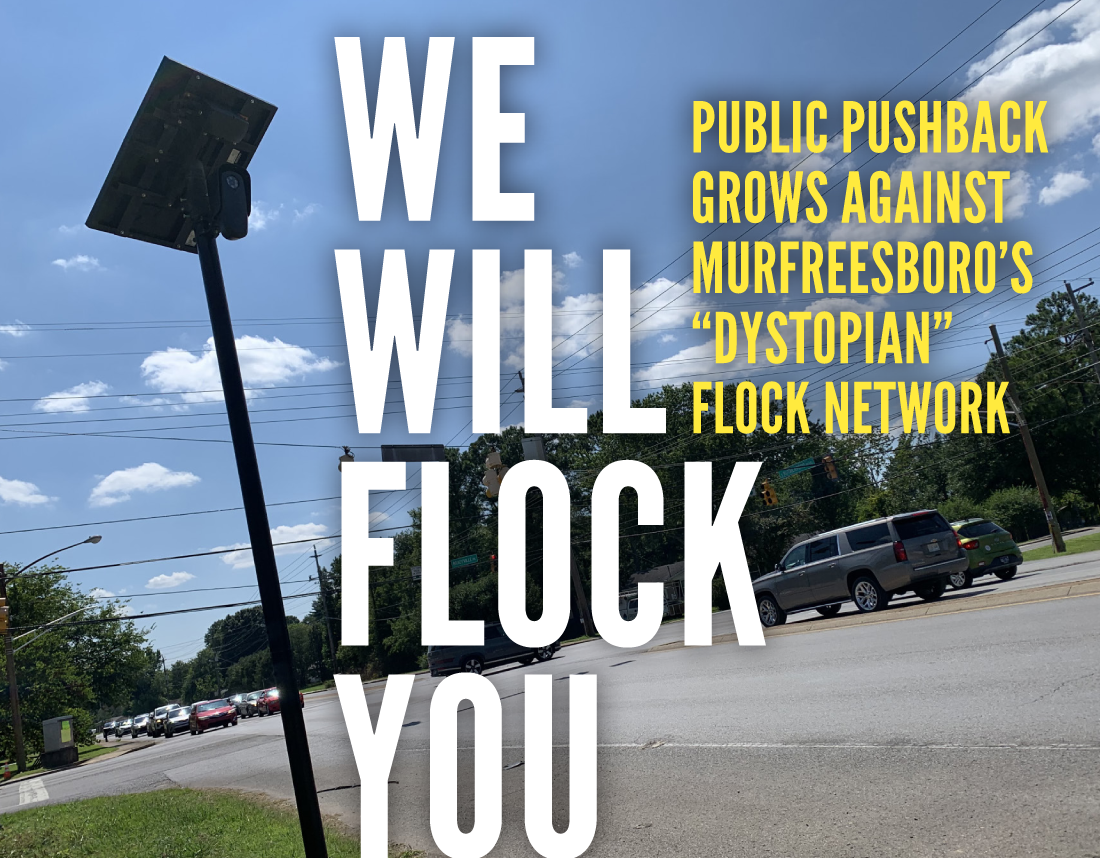
The right of the people to be secure in their persons, houses, papers, and effects, against unreasonable searches and seizures, shall not be violated, and no Warrants shall issue, but upon probable cause, supported by Oath or affirmation, and particularly describing the place to be searched, and the persons or things to be seized.
— Amendment IV, Constitution of the United States of America
___
More and more cities across Tennessee, and the country, are opting to remove, disable or cancel contracts regarding Flock license plate readers. Murfreesboro officials, meanwhile, are reaffirming their support for them amidst growing public awareness of and pushback against the surveillance and vehicle tracking network, implemented and funded by municipal governments, built and maintained by a private company.
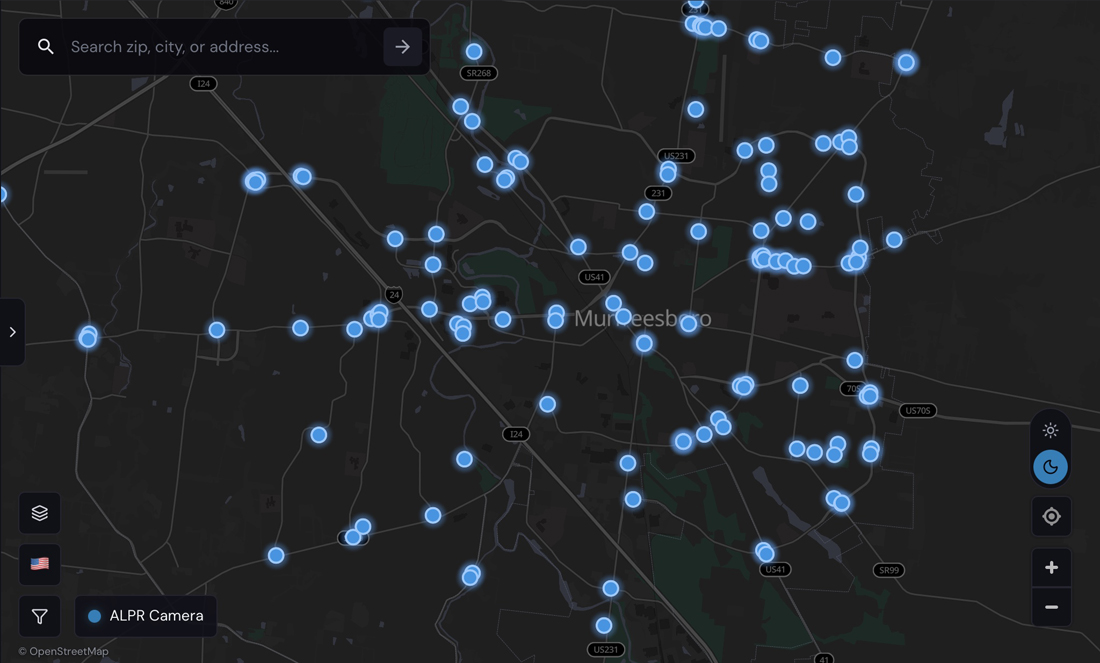
Flock Map of Rutherford County, maps.deflock.org
Murfreesboro has installed over 100 of these LPRs around town, constantly capturing images of passing vehicles, compiling and archiving license plate information.
Many local residents have directly expressed to the Murfreesboro City Council exactly what they think about the devices, some referring to the council members who approved the Flock cameras as a group of “tyrants.”
“We don’t like surveillance that we didn’t consent to,” Murfreesboro resident Pamela Jones told the city council at an August meeting. “We don’t like a city council who doesn’t seem to care what we think. You know this is wrong.”
While many are not comfortable with the fact that local law enforcement has access to vehicular travel data, some take particular issue with a private company—the Georgia-based Flock Safety, which has grown rapidly since its 2017 founding, now leasing its devices to thousands of cities and organizations across the country—gathering, and potentially selling, data on motorists.
“It’s $517,000 of taxpayer money so that a private company can track our movement,” said another local resident, Zoe McDowell. “It’s dystopian and it does not belong in Murfreesboro.”
Members of the city council, responsible for bringing the technology to Murfreesboro, stand by the data gathering and movement tracking that the license plate readers allow.
“I support Flock cameras because they are a valuable tool that helps our police solve crimes and keep our community safe,” said Murfreesboro City Councilman Austin Maxwell.
Many onlookers point out the irony that leaders such as Maxwell from the Republican Party—formerly the party of smaller government and individual rights—are the ones responsible for and supportive of the surveillance network.

“There seems to be a high concentration of the ‘don’t tread on me’ crowd that’s loving them,” one Tennessee resident posted to social media.
Another area resident, Matt Hew, points out that according to Flock’s patents, it operates tracking software “capable of categorizing by height, weight, race, gender, clothing type, facial recognition—you name it.”
While Murfreesboro law enforcement officers have access to license plate and vehicle information, Hew muses that “I guess it never occurred to the police that you don’t own data that’s on somebody else’s private server and has gone through a dozen hands. Likewise, the city never thought to ask ‘who owns the data not defined in the MSA [Master Services Agreement]?’ and ‘what encryption exists to prevent the third parties mentioned in the contract from accessing the data?’ You have no idea what those companies are doing with that data and zero influence as to how they use it.”
Recently, several local governments in Tennessee voted to end contracts and remove Flock Safety LPRs and other advanced surveillance tools, due to growing resident concerns over data privacy and civil liberties.
Knox County voted unanimously in September to remove all of its 143 Flock cameras and restrict local government drone surveillance.
Meanwhile, the small town of Coopertown in Robertson County voted to remove its six Flock cameras following public pushback. The police chief there said Coopertown officers searched for records on 769 plates—in a town with a population of about 5,000 people, according to reports.
Sullivan County and Collegedale officials have also moved away from Flock technology.
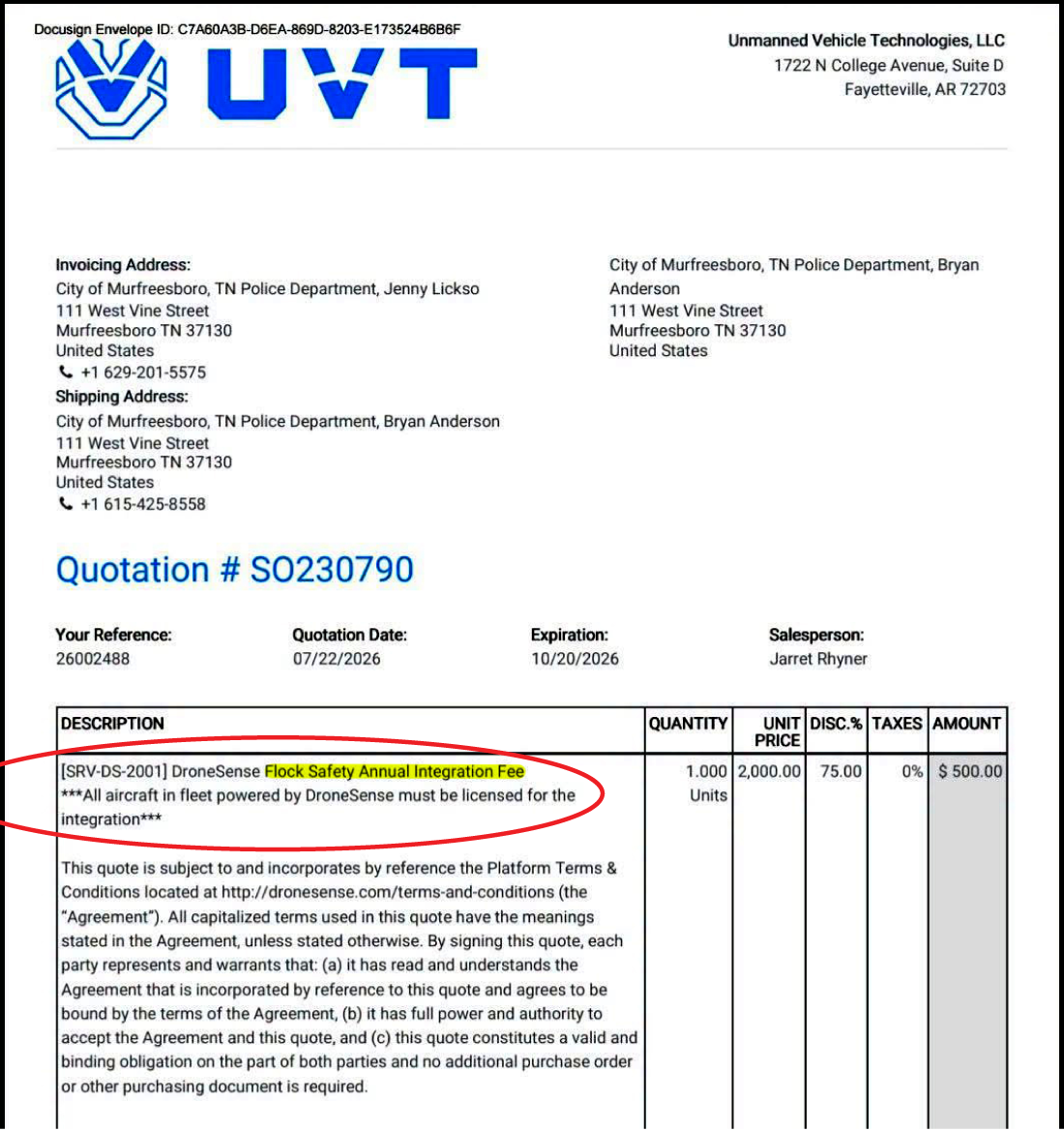
Prior to a September meeting of the Murfreesboro City Council, an agenda item involving an invoice to purchase “DroneSense Flock Safety Integration” software drew public suspicion and outcry.
“I always wondered how dystopian novels got to where they were,” Jake Fuqua quipped.
Some suggested this integration package was for eventually launching an automated Drone as First Responder program in Murfreesboro, but the Murfreesboro Police and city council members insisted that the request was not a step toward setting up DFR locally.
Still, more community members attended that Sept. 17 meeting to address the council and speak in opposition to local government growing its surveillance network in any form.
“It’s almost like you guys are hiding something,” said Nikhil Patel, regarding the council’s efforts to gain control of the narrative and focus on the fact that they are not instituting a Drone as First Responder program at this time, when many want to do away with Flock devices and police drones completely.
“Adding features on this [DroneSense Flock Safety Integration] system, once it’s linked, is always possible in the near future,” Patel said. “Its makes that possibility one step easier. The council was never honest about Flock a few years back. How can we trust you are telling the truth? We will not get tired of showing up to oppose Flock or anything associated with Flock.”
Jay Hill, part of the Flock Block Murfreesboro movement, said that “nobody is claiming a fully autonomous [police drone] fleet launches tomorrow morning,” but that “paying a fee for DroneSense Flock Safety integration is the foundational software prerequisite to bridge ground-level Flock cameras with overhead aerial tracking. They are already tracking us with Flock cameras on the streets, and now they are purchasing a license for a platform that is marketed, designed, and sold specifically for automated DFR deployment.”
Jeffery Wegner told the council that local residents opposed to government surveillance “are going to continue keeping a very close eye on y’all, because you are keeping a very close eye on us.”
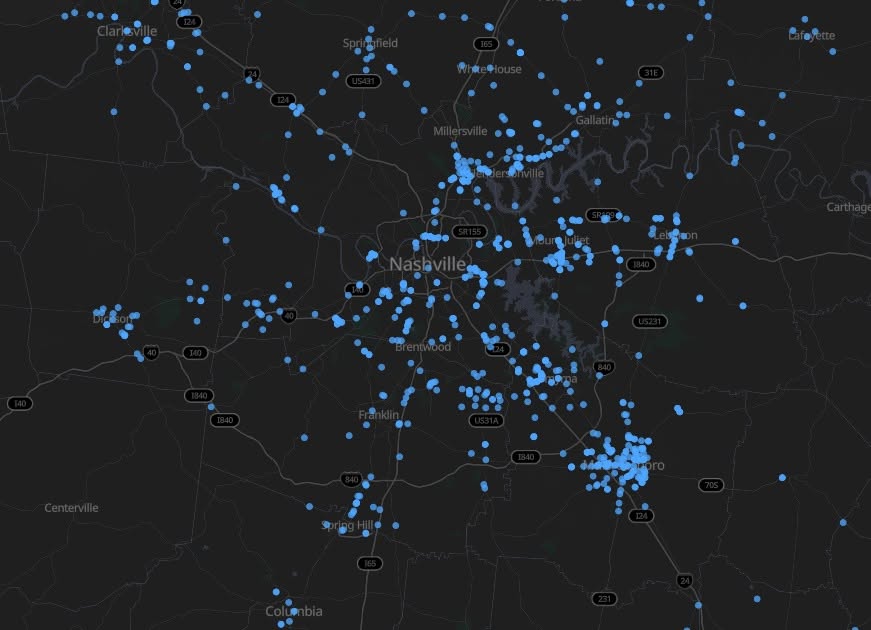
Flock Map of Middle Tennessee, maps.deflock.org
“Flock is immoral, unconstitutional and a violation of our values,” Wegner said. “I do not want to take a step closer to mass surveillance, where we live in a police state, surrounded by cameras constantly, every moment of our life, mass surveillance. I would like to take a step back from that.”
While the outcry grows louder, plenty of citizens do say that they support the Flock cameras, see their benefit and find them legal and acceptable.
“The truth is, anyone—private citizen or government—can record in any public space,” Josh Lawson said. “Learn the laws we live under, folks.”
Others seem willing to give up some privacy in case the system may be useful in finding a stolen car, missing loved one, or criminal.
Though another individual, Eason Syler, estimated that “the majority do not want drones nor cameras continuously monitoring them.”
Murfreesboro Police stand by the Flock cameras, citing their usefulness in helping locate the whereabouts of multiple area criminals.
Others point out that smartphones pose far greater privacy risks and data tracking capabilities than the license plate readers. Those wanting to avoid being tracked should first “toss out your phone and drive a vehicle from the ’90s,” as one puts it.
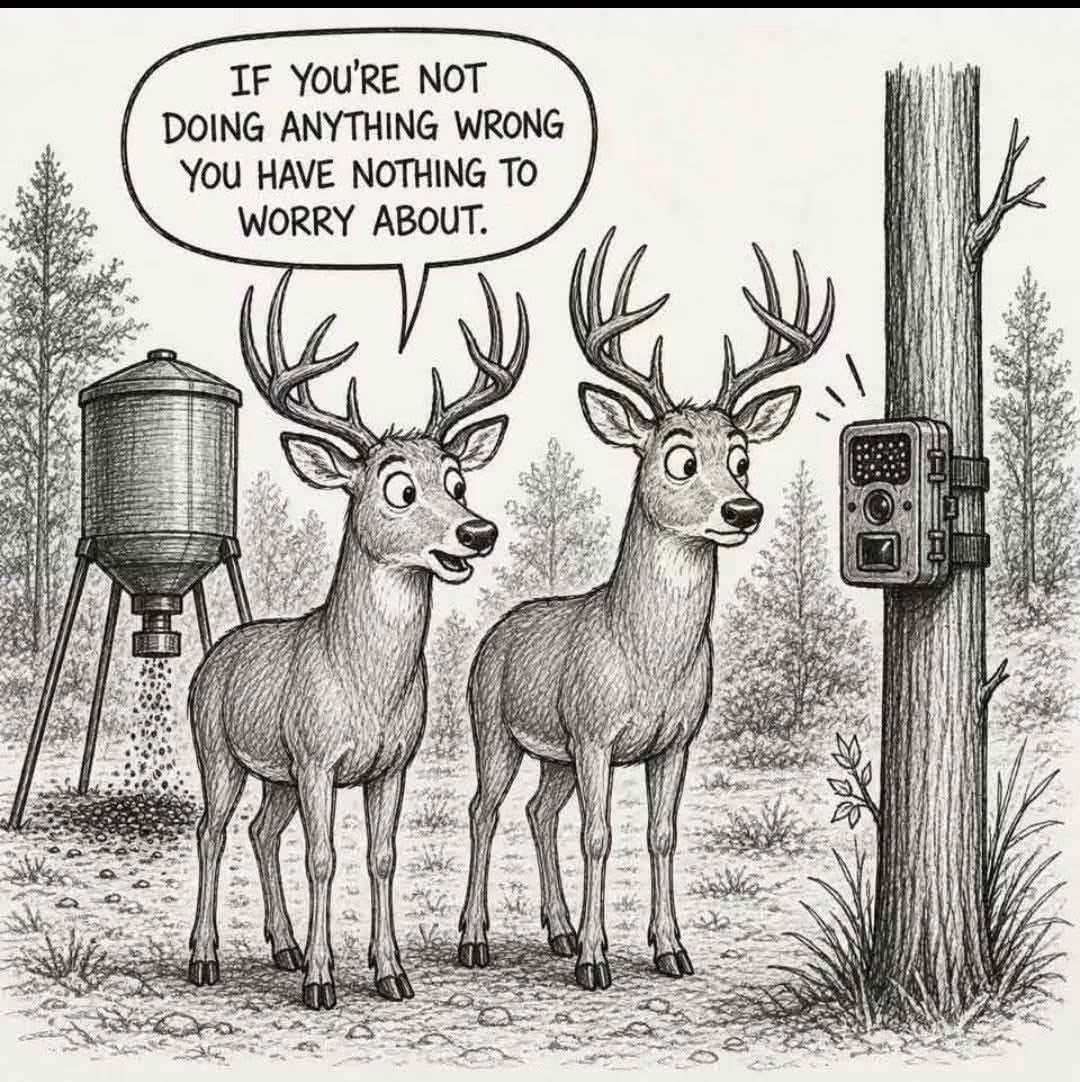
While many Murfreesboro residents acknowledge that multiple other important privacy and technology questions loom over modern society, they remain steadfast that they do not want their local government and their tax dollars being used to grow such a surveillance state.
“This issue is more nuanced than either side is making it out to be. I can absolutely see the value in using technology to recover stolen vehicles, locate missing people, and solve violent crimes,” Nathaniel Curl posted. “At the same time, technology has advanced much faster than our privacy laws. My concern isn’t that these tools exist, it’s that the rules surrounding them haven’t kept up. If private companies are performing government functions and handling public data, they should be held to a higher standard of accountability, transparency, and oversight than ordinary businesses. We need modern, common sense privacy laws that clearly define what data can be collected, how long it can be retained, who can access it, how it can be shared, and meaningful penalties for misuse.
“If the public is being asked to accept greater surveillance in the name of public safety, then the public should get something in return: stronger privacy rights, independent oversight, and real transparency,” Curl said. “Public safety and privacy don’t have to be mutually exclusive. Good laws should protect both.”
Sean Patrick Grimes references Benjamin Franklin’s words: “Those who would give up essential liberty, to purchase a little temporary safety, deserve neither liberty nor safety.”
He said he presented that concept to Murfreesboro Mayor Shane McFarland following a city council meeting; the mayor’s “response was simply that it ‘doesn’t apply to this situation.’ I respectfully disagree,” Grimes said.
While he thanked the mayor for personally taking the time to speak about Flock LPRs and concerns surrounding mass surveillance, “responses to concerns about potential Fourth Amendment violations were disappointing.”
While the network of Flock license plate readers in themselves trouble liberty-minded citizens, and the idea of local law enforcement agencies helping implement systems to monitor vehicular traffic data on behalf of a private company and its vendors and customers doesn’t sit right with persons of various political persuasions, many now ask: what comes next? What bright surveillance technology ideas will the government seek to implement next? Weaponized drones? Cameras that see inside of homes? A system that automatically flags and tickets violators in the next “pandemic” or “emergency,” in the name of “public safety”? Robots on the police force?
“This is just the beginning,” Philip Austin said.
As far as the LPRs, another local resident, Josh Tallman, said “I’ll predict the future . . . They’ll take the Flocks down and replace them with Axon cameras [from the company that manufactures police body cameras], just to make the citizens think that their voice was heard. Let’s see.”
“I agree,” Barbara Ferguson said. “These [Axon] cameras . . . are probably worse. They install them into street lights and it can be done by a city municipal worker in minutes and you’ll never even know where they are located.”