


Parents: Put down your phones. Stop your scrolling and read to your children. FULL STOP.
Statistics tell us that 40% of our nation’s children can not read and 65% of fourth graders are not reading at grade level. We have a literacy crisis.
A 2025 study conducted by Harper Collins UK and NielsenIQ found that “Fewer than half of parents of children up to 13 years old say reading aloud to children is ‘fun for me.’ Gen Z parents, who grew up with technology themselves, are significantly more likely than Millennials or Gen X to view reading as ‘more a subject to learn’ rather than a fun or enriching activity” and that “many parents don’t find enjoyment in reading to their children.”
What a sad testament to parenting if you opt out of something because it simply isn’t “fun” for you as a parent, even though you know it is extremely beneficial for your child. That is a glaring, self-centered picture of today’s society.
Cultivate Love for Reading
Our home school, for the last 22 years, has revolved around reading classic literature and living books (narrative, story-driven books, rather than textbooks confined to a single subject or workbooks). Writers create living books to engage the reader. They are not like your traditional textbooks that are comprised of facts related to a single subject. Living books are typically written in a narrative form or as if a conversation is taking place. Living books encourage the reader to think and are inspiring.
My favorite part of our home-school day has always been when all my children would gather for family read-aloud time. Not only was this time important academically but it also served as a valuable family connection time. Books would lead to lengthy discussions and often spark an interest that would be explored. Fostering a love of reading has been a focal point of my children’s home education.
Reading utilizes all areas of the brain. It is one of the single most important things you can do for your child.
“Pre-reading children who participated in regular literacy activities, like being read to, showed enhanced white matter development in regions involved in recognizing written words and understanding language,” according to Science Insights. “Reading doesn’t just use existing brain infrastructure. It builds new infrastructure.”
Reading Comprehension is Key
A child’s inability to read and comprehend will also affect all subject areas.
“Low ACT scores are symptomatic of one prevailing problem: poor reading comprehension,” according to 36 University, an ACT prep program. “Many times low ACT scores can be traced back to a student’s ability to read and comprehend.”
For many individuals, reading comprehension issues continue to be an albatross in the workforce and in other areas of their adult lives.
The National Literacy Institute reports that:
– 3 out out of 4 people on welfare can’t read
– 20% of Americans read below the level needed to earn a living wage
– 50% of the unemployed between the ages of 16 and 21 cannot read well enough to be considered functionally literate
– Between 46% and 51% of American adults have an income well below the poverty level because of their inability to read
– Illiteracy costs American taxpayers an estimated $20 billion each year
Reading comprehension touches every aspect of our lives and is a major indicator of future success. If this doesn’t motivate parents to take responsibility for their children’s development and education, I am not sure what will. You owe it to your children to make reading a priority in your home regardless of your educational choices.
Do not abdicate your parental responsibility to anyone else. If you send your children to public or private school it is still your responsibility, as their parent, to read to your children and have them read to you.
I have taught hundreds of children to read throughout the years, both as a public school teacher and tutor, and as a home-school parent. I have always emphasized to parents the importance of reading to their children. I could always tell the parents who made it a priority and the ones who did not. It was glaringly obvious. Excuses were plentiful such as: I don’t have time (yet you spend hours on your phone). They won’t sit still (give them something to do like LEGOs, puzzles, crocheting, small quiet toys, etc. while you read). They don’t listen (Find an engaging book and make it fun). The list goes on but ultimately what those parents were really saying was, “I do not want to put in the work.”
Don’t make excuses, just invest in your children. A library card is free. Providing your children with access to good quality books is not expensive, but robbing them of books and the ability to read is.
Once the family read-aloud tradition has been established with the parent, modeling what it will look like, have your children begin to read aloud to the family as their reading skills progress. You will be amazed at the progress they will make and how this will change your family dynamic.
Choose books together and explore different genres. I have built entire curricula around living books. If you are interested in a list of living books and classics that I recommend, feel free to contact me via my website at freeyourchildren.com.
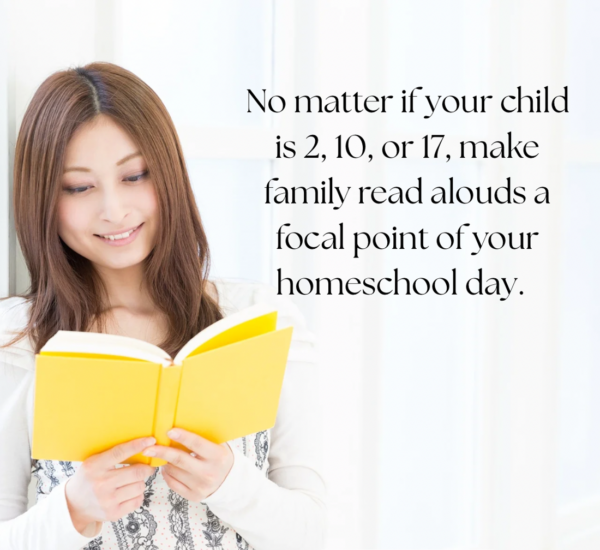
You may have grown up in a home where reading was not a priority. If not, break the cycle. No matter if your child is 2, 10 or 17, make family read-alouds a focal point of your home. Your book choices can lead to family adventures and experiences enjoyed together while making memories.
You will never regret the time you pour into your family. You will regret the time that you spend on less important pursuits. You only have a short window of time with your children, and it is your responsibility as their parent to give them a good foundation. Set them up for success and cultivate a love of reading.
Readers become lifelong learners, and that is the real point of education.
___
Photo, top, courtesy of Werner Pfennig / Pexels