

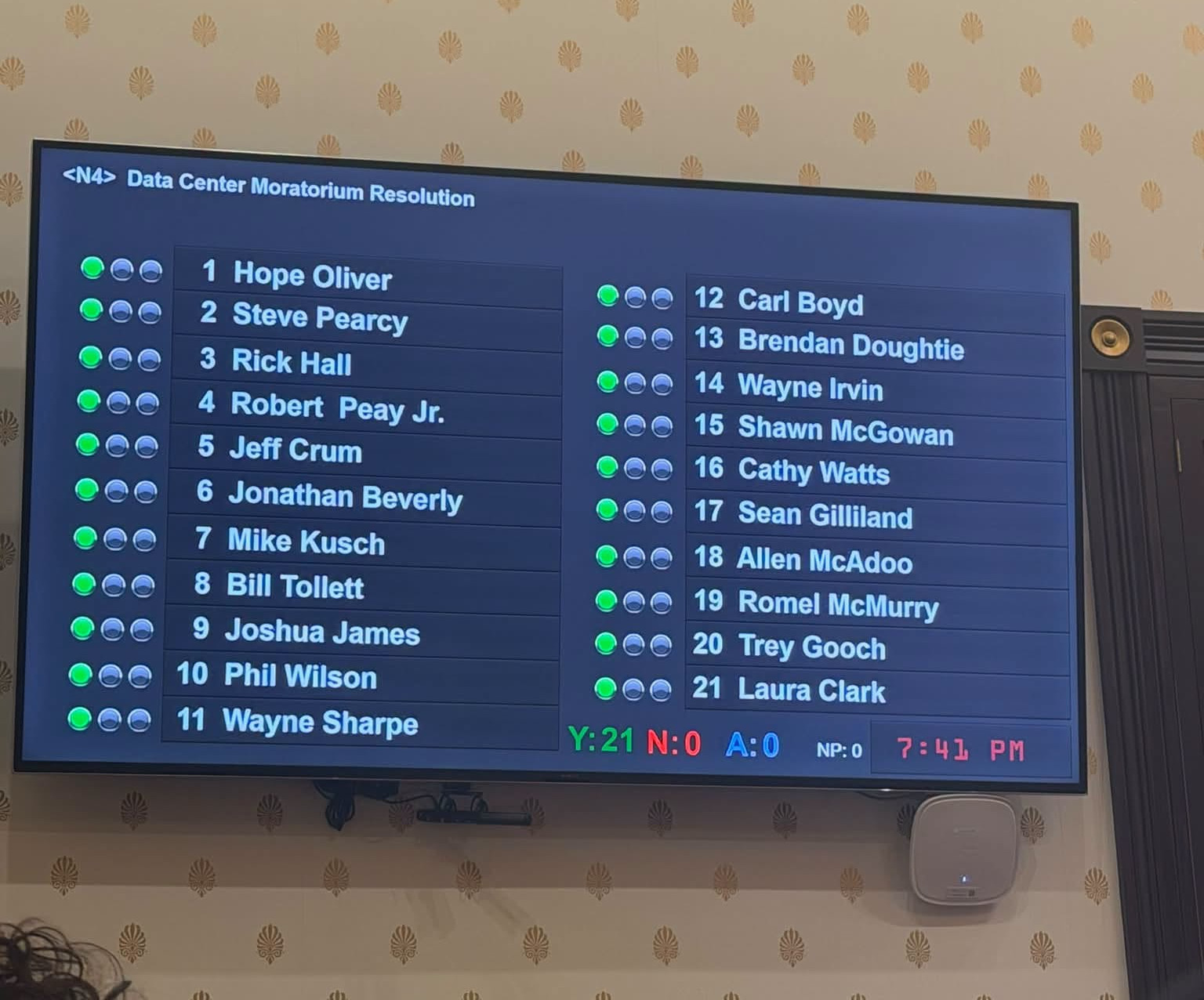
In November, the Rutherford County Commission passed a one-year pause on new data center applications in the county’s unincorporated areas.
County staff told the Planning Commission that no applications are pending, and no inquiries have been made for data centers in Rutherford County.
However, the county’s zoning ordinance contained nothing written with these data center facilities in mind. The new resolution says as much, citing energy consumption, noise, and land-use compatibility, and noting that current rules were not written for high-impact computing uses.
The point is not to stop anything. It is to define the parameters before somebody wants to come in, rather than learning on the fly once an application is on the table.
This Was a Campaign Issue
One thing that separates Rutherford County from Memphis, is the people voting on this campaigned on this issue. That matters for how you read the vote. This is not a commission reacting to a proposal. Some of the commission members elected in August are now acting on something they campaigned on.
The Three Limits
Whether a pause adds anything. “What does a moratorium give us that our current regulation doesn’t already provide?” It is a fair question. Planning Director Doug Demosi said a pause puts staff in a better position to respond while regulations are written.
The state. Tennessee already acted. Tennessee Public Chapter 961 bars a municipality or utility from absorbing electrical infrastructure costs for data centers projected to draw 50 megawatts or more in their first three years. A county writes rules in whatever space the General Assembly leaves it.
The county line. Commissioner Rick Hall told the room after a Rutherford County Commission vote that this pause covers unincorporated Rutherford County only, not Murfreesboro, Smyrna, La Vergne or Eagleville. Those cities handle their own zoning. A project turned down at the county commission level does not necessarily die.
That is not an argument against a pause. It is an argument for asking what the four cities are doing while the county spends a year writing standards, and whether anyone is coordinating them.
What Happened in Memphis
On Oct. 20, after two postponements and a meeting that broke down badly enough to clear the chamber, the Memphis City Council finally voted. The longer moratorium failed 6-6, with one sponsor absent.
Minutes later, the council passed something else. Substitute Ordinance 5988 pauses approval of data center applications for 135 days, through early March, and directs the city’s planning division to study where such facilities can go, define what a data center is, develop expansion standards, and draft code amendments. It passed 7-5. The meeting ran nearly six hours, three of them public comment, with the chamber at capacity.
The ordinance was substituted and amended late and was not available for members to read before the vote. The Commercial Appeal reported council members left unclear about what they had passed.
Nine weeks, five meetings and one cleared chamber, to reach a four-and-a-half-month clock and a homework assignment, with a 300-megawatt facility running the whole time.
The Difference
Memphis wrote under pressure, in public, with the thing already built and litigation in the background. A federal judge has since dismissed the suit a data center company brought against Metro Nashville’s moratorium. However, the company says it will amend, and Nashville’s pause holds through Dec. 1. I wrote last month that Nashville was defending that case, which I should correct.
Rutherford County would be writing with no applicant and no deadline.
What Happens Next
Rutherford County has one commercial data center. Memphis Light, Gas & Water told its council in September that it serves 16.
If nobody is knocking, a commissioner can fairly ask “Why the rush?”. Memphis answers that by the time somebody knocks, the easy version of this conversation is over.