

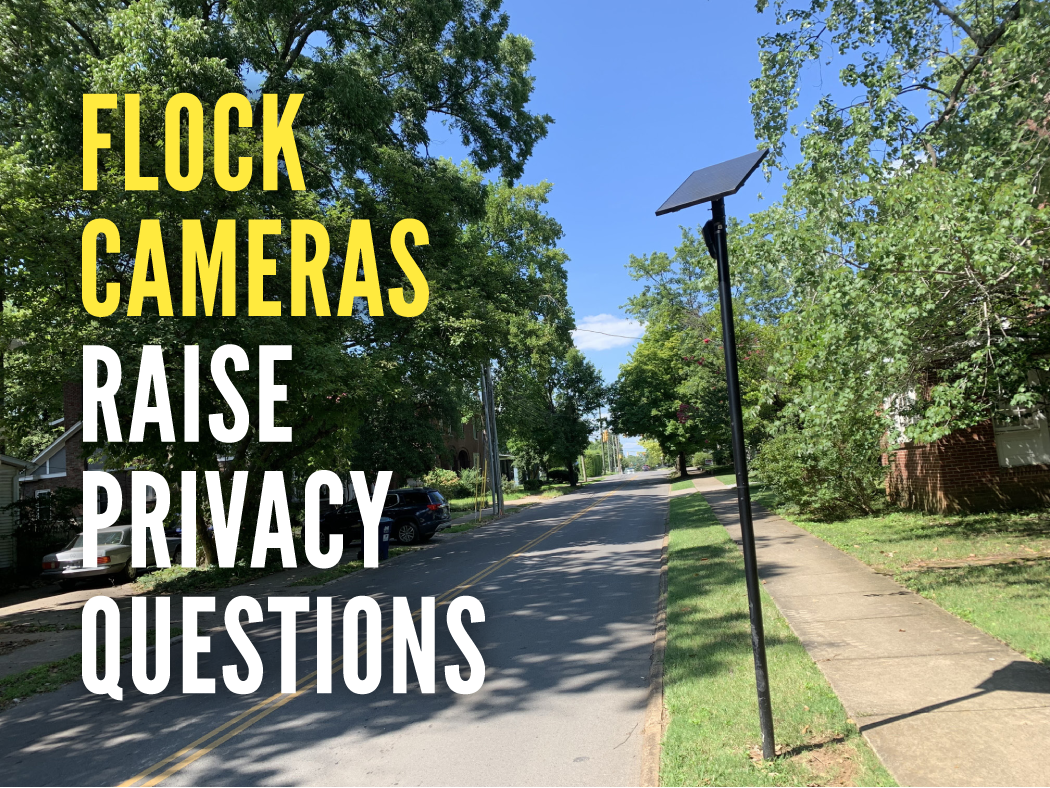
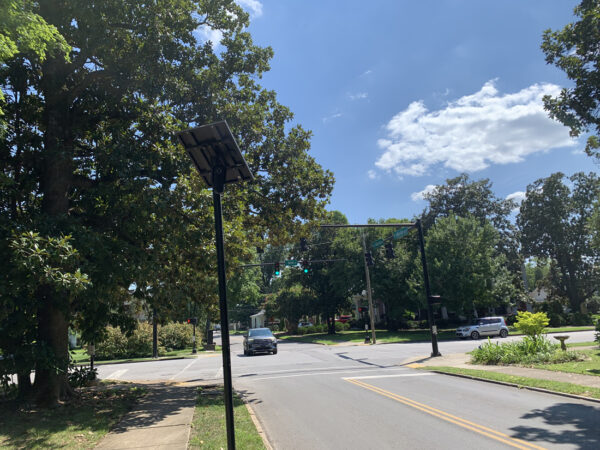
You’re driving down a Murfreesboro road and see a new camera set up on a black pole. What is it for? Are you being recorded? It’s likely a Flock Safety license plate reader, part of a recently growing automated system used by the Murfreesboro Police Department and many other law enforcement agencies.
According to MPD’s Real Time Crime Center webpage, the systems “capture images of vehicles and use software to process the vehicle’s license plate information.” MPD says the cameras identify vehicles, not people, and do not use facial recognition.
Critics, however, say the systems make it too easy for law enforcement to track motorists’ movement in real time, and to target and surveil citizens with no probable cause, warrant, case number or active investigation, and strongly object to the network of cameras, citing concerns of privacy and the growing surveillance state.
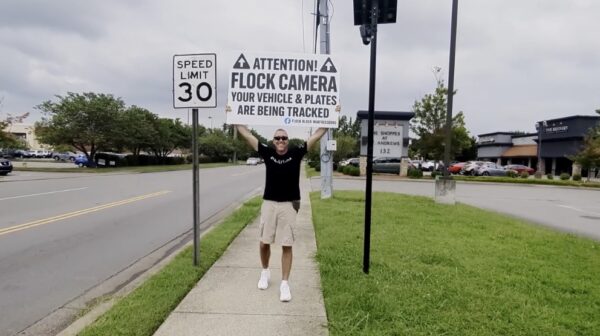
Earlier this year, Murfreesboro resident and privacy advocate Jay Hill created an online petition titled “Flock Block Murfreesboro” to raise awareness about what he describes as a lack of public consent and transparency, along with concerns about data privacy, information sharing and potential misuse. As of July 28, the petition had received 1,100 verified signatures.
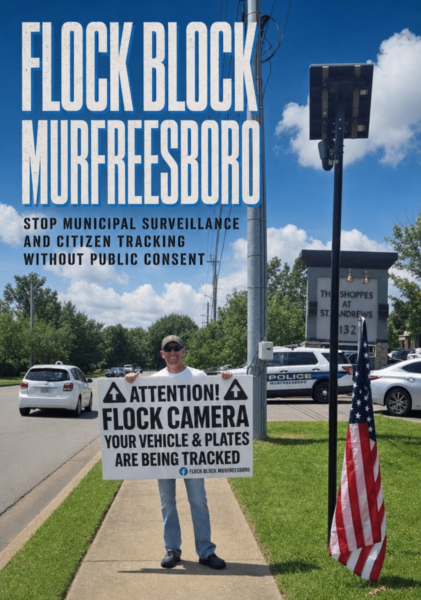
A growing number of U.S. cities across the country have already removed or deactivated Flock Safety license plate readers after public outcry, according to reports.
Eugene, Oregon, ordered a pause on its network of Flock cameras after its internal police audit showed that federal agencies had accessed and searched the local system without city authorization.
The mayor of Appleton, Wisconsin, raised “concerns about the integrity of Flock’s underlying system.” That city announced it would stop using Flock cameras, and Knox County, Tennessee, is discussing the controversy surrounding its Flock network amidst public pushback there, with Knox County Mayor Glenn Jacobs saying that Flock cameras and their AI-driven system “have no place in Knox County.”
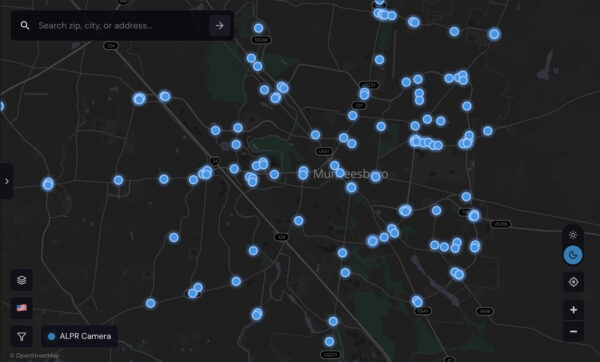
The Murfreesboro Police Department now currently operates 106 Flock license plate readers (Flock being the brand name of the private company manufacturing the devices). Locations were selected primarily based on historical crime data and trends and traffic patterns within Murfreesboro city limits, according to information from MPD Real Time Crime Center Supervisor Ryan Lawrence.
Many of these are located near the city’s major intersections, busy parts of town that see heavy traffic flow. The city has, however, placed some cameras directly in the midst of quiet residential neighborhoods as well.
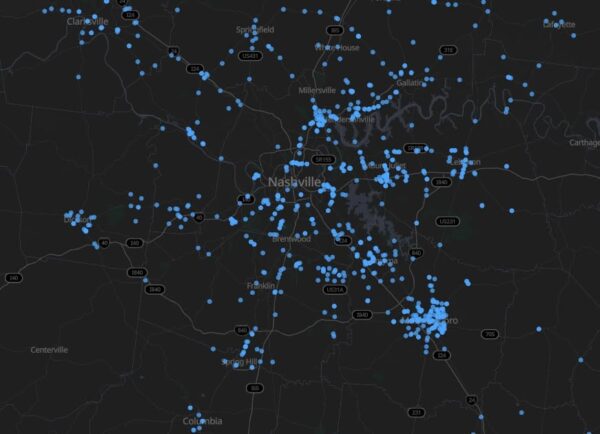
Other Flock cameras are located on the outskirts of Murfreesboro, with a growing system in Smyrna, and in communities all over the country.
MPD said it can use separate law enforcement databases to connect a license plate with its registered owner and other personal information. However, the department said the Flock Safety system does not directly access those databases, meaning personal information cannot be retrieved directly from the LPR system.
Hill said his ultimate goal is the complete removal of the cameras. He said data retention policies and requirements that searches have a legitimate law enforcement purpose do not do enough to prevent misuse.
“We should not trade our constitutional rights for law enforcement convenience,” Hill said.
Hill said his concerns intensified after he obtained audit logs through a public records request covering searches conducted from Nov. 10–25, 2025. According to Hill, many searches contained blank case-number fields or general entries such as “Lookup” and “Night Shift Case” instead of an incident number.
“Without a legitimate case number, there is zero paper trail tying a search to an official incident,” Hill said.
According to MPD’s Real Time Crime Center webpage, the department uses LPR systems to identify and locate vehicles of interest to law enforcement. The webpage says scanned plates are compared with law enforcement databases containing plate numbers for vehicles associated with active investigations, including missing-person cases, Amber or Silver Alerts, stolen vehicles and stolen license plates. It also says stored plate information may help investigators identify vehicles associated with crimes and develop leads.
Paul Engel, who has studied the Constitution and related documents for almost 15 years, said he does not believe recording vehicles and license plates visible from public roads is itself unconstitutional. In his view, the primary concerns involve data retention, security and how government officials search the collected information.
MPD said no current law or department policy requires it to obtain a warrant or establish an emergency justification before searching historical LPR data.
Engel questioned whether a 30-day retention policy and a requirement that searches have a legitimate law enforcement purpose provide enough protection without clear enforcement procedures.
“Those are just words,” Engel said. “I would ask what procedures are in place to make sure these goals are met.”
Engel said safeguards should include proper training, an audit trail, regular reviews and consequences for anyone who accesses the system improperly. He also cautioned officers against treating a possible match as proof that a vehicle or its occupants are connected to a crime.
“Flock and other systems are only tools,” Engel said. “They are not to replace proper investigations.”
Hill believes the current safeguards are not enough and continues to call for the cameras’ removal.
MPD said users must select an offense type and enter a justification in a required Search Reason field, while the separate Case Number field is optional. According to the department, personnel routinely enter the applicable case number, incident number or other law enforcement justification in the required Search Reason field.
MPD said the publicly posted audit logs were redacted records produced in response to an open records request. The department said an empty Case Number field does not indicate that a search lacked a legitimate law enforcement purpose.
Search access is limited to personnel assigned to MPD’s Real Time Crime Center, according to the department. Lawrence said those personnel receive training on system operation and applicable laws, policies and procedures. The department said access logs are audited internally at least quarterly, no audit has identified an unauthorized or improper search, and audit findings are public records.
MPD also says most images are never reviewed because they are not relevant to an investigation. The department currently retains LPR data for 30 days, after which it is automatically deleted and no longer accessible. Data relevant to an investigation may be retained. Under Tennessee Code Annotated Section 55-10-302, captured plate data generally may not be stored longer than 90 days unless it is retained as part of an ongoing investigation. The law requires the data to be destroyed when the investigation or any resulting criminal action concludes.
MPD’s Real Time Crime Center webpage states that all images and metadata are encrypted throughout their life cycle, from the device to cloud storage.
One Murfreesboro resident, who rented on Brown Drive, said he finds the devices evidence of “local law enforcement’s disregard for privacy and peace.”
“Without warning, a Flock camera appeared in my front lawn—the first I had ever seen. No one bothered to notify me, knock on my door, or even ask permission. They simply installed it,” said Matthew Olson. “Is Brown Drive now under constant surveillance from both Flock cameras and drones?”
Ken Mayer, an assistant professor of computing at Lipscomb University’s School of Computing, said the license plate reader technology can capture a vehicle’s make, type, color, license plate and distinguishing features, including damage or alterations. It also records where the vehicle passed the camera before transmitting the information to a cloud-based database.
Mayer, who said he has researched privacy for 25 years, explained that computer vision and machine learning allow the system to identify and categorize those details. However, technology can still make mistakes.
According to Mayer, rain or dirt on the camera lens and similar-looking letters and numbers can affect a plate reading. For example, a system could mistake the letter “O” for the number zero.
MPD said an LPR alert alone does not establish reasonable suspicion for a traffic stop or detention. Before making a stop or detention, an officer must visually confirm that the license plate matches the information in the alert. MPD also said all LPR alerts must be confirmed through the National Crime Information Center by Communications before criminal charges can be initiated.
Although MPD describes each image as a “moment-in-time” capture rather than constant surveillance, Mayer said data collected by multiple cameras could be connected to reveal patterns in a vehicle’s movements. Sharing information with other law enforcement agencies could allow those patterns to extend beyond one city, he said.
Mayer said storing the information on a private company’s system also creates questions about who can access it, how long it is kept, and whether it could be used for purposes beyond the original investigation.
“What is the longest we hold this data and at which point does this give the government more data than they should have access to?” Mayer asked.
MPD said it owns the data, does not sell it and does not share it with people or organizations outside law enforcement. The department directs the public to its Flock Transparency Portal for a list of law enforcement agencies with access to Murfreesboro’s data. MPD said outside agencies are responsible for establishing their own auditing procedures and complying with applicable laws and policies.
A subset of Flock Safety employees can view MPD’s LPR data to troubleshoot performance issues, but the department said those employees cannot access it without MPD’s express permission.
Mayer said an independent group outside city control should review access records and other safeguards. He said audit logs should show who accessed the system, when it was accessed and what the user searched for.
Copies of city contracts provided by Hill show that the city first agreed to purchase 15 license plate reader cameras under an agreement effective Aug. 1, 2025. That contract totals $128,250 over three years, or $42,750 annually.
An amendment effective Sept. 19, 2025, authorized the purchase of additional equipment for Murfreesboro parks and greenways. It lists 17 standalone license plate readers, eight dual-camera license plate reader bundles, one combined license plate reader and video unit, 23 pan-tilt-zoom video cameras and two fixed video cameras.
The 2025 Murfreesboro amendment allocates over half a million dollars over three years to the system: $195,515.10 for the first year and $161,158.80 in each of the following two years. Combined with the earlier $128,250 agreement, the two 2025 agreements total $646,082.70. The agreements cover license plate readers, video equipment and related services.
The contracts show that the city used Omnia Partners Cooperative Contract No. R250203 to purchase the equipment and services. They state that Flock Safety’s services include site and safety assessments, camera setup and testing, and shipping and handling. Flock Safety and the city also collaborate on a deployment plan for camera locations.

“We need the police to be able to do their jobs effectively,” Mayer said. However, he said officials should be open with residents about the surveillance technology being used and allow detailed public discussion.
The system and their concerns raise a central question for Murfreesboro to consider: How should the city use technology that may help solve crimes while protecting residents from unnecessary surveillance and misuse?
View a map of Flock camera locations at maps.deflock.org.