

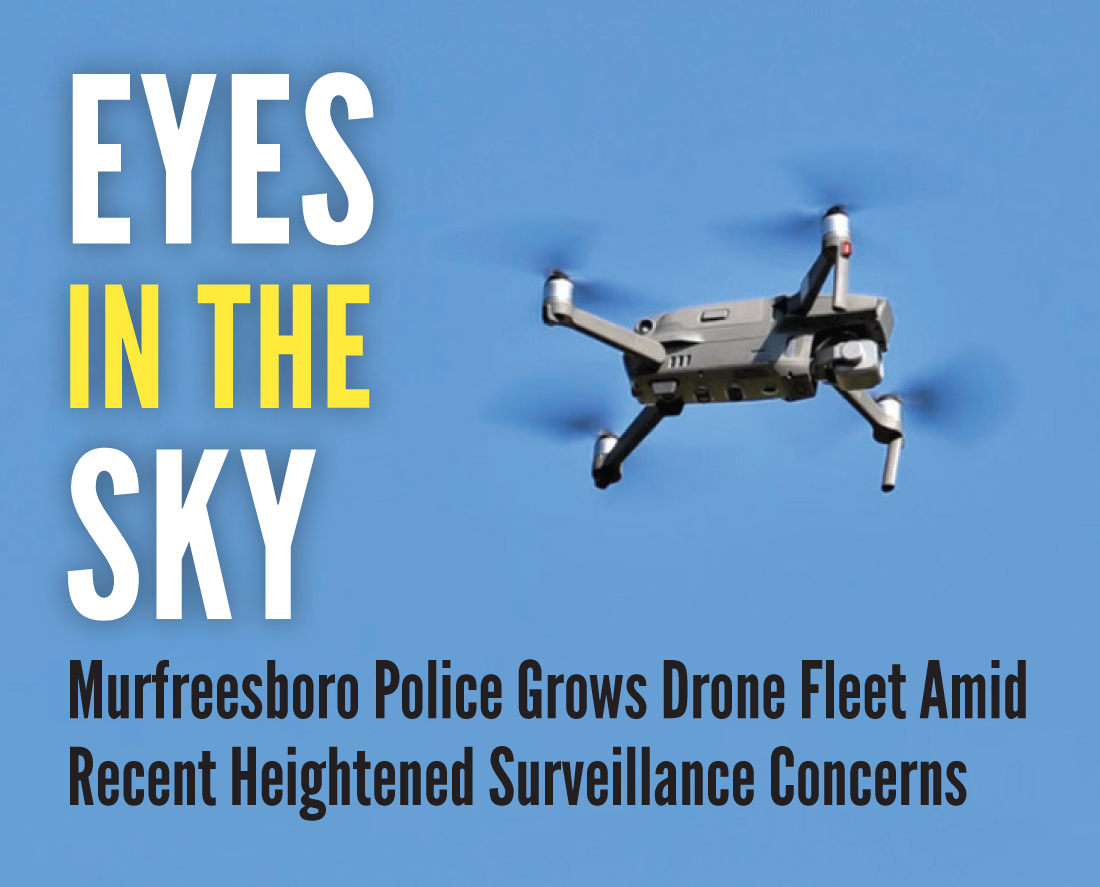
There are more eyes in the sky than ever before, and some of them in Murfreesboro are drones that belong to the police department.
Drone as First Responder programs are expanding rapidly across the country, a surge driven by a Federal Aviation Administration decision last year to streamline the waiver process that lets police departments fly drones beyond visual line of sight.
Previously, police departments needed a pilot or observer to keep a drone within eyesight at all times. Under the new waivers, police can remotely dispatch drones to a scene without anyone tracking them by sight.
The premise behind these Drone as First Responder programs is fairly simple. FAA-certified police officers dispatch drones from a central police building and fly them remotely beyond visual line of sight. Depending on the department’s policy, the drones are deployed for specific emergency calls or active criminal investigations. The major benefit is that drones can arrive on a scene faster than a patrol car and gather “situational awareness” from above.
Larry Flowers, a Public Safety Information Officer for the Murfreesboro Police Department, says MPD is currently evaluating a DFR program, though it has not yet decided to establish one. City council approval would be required if MPD established such a program, Flowers says.
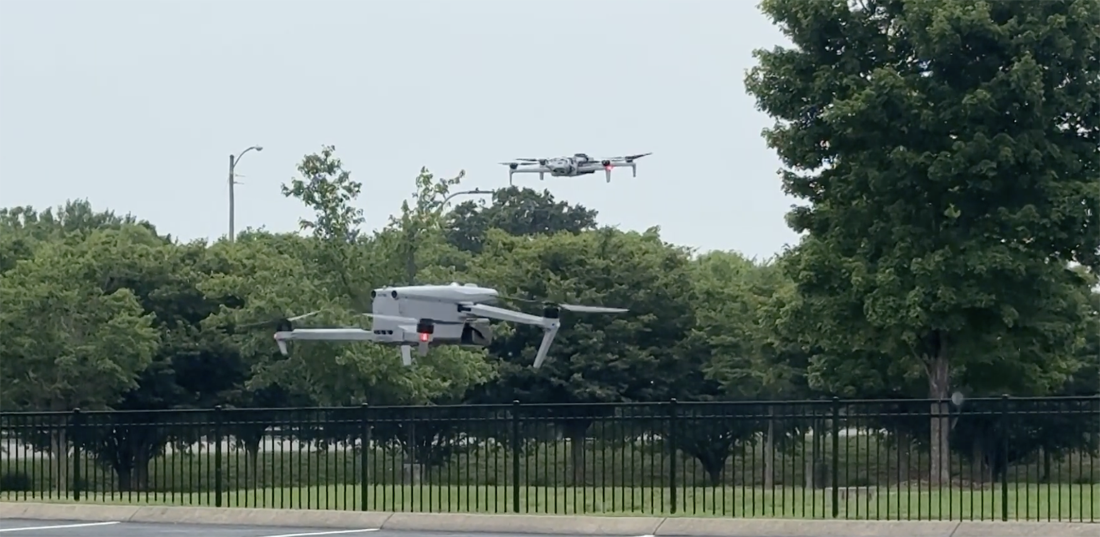
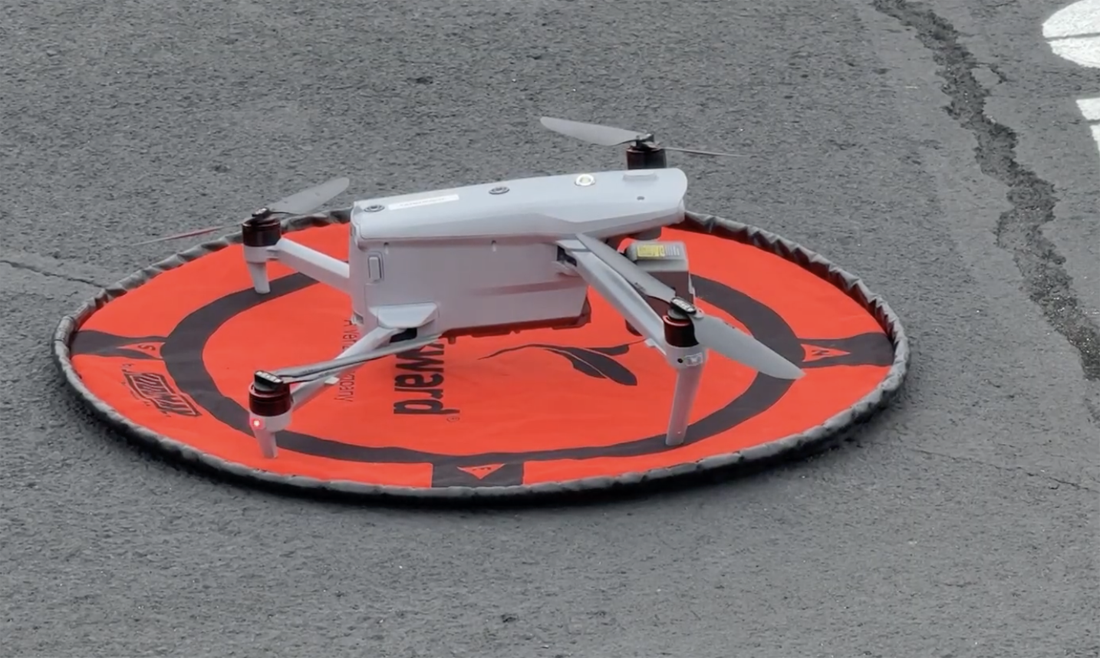
Murfreesboro police are no strangers to drones, however, and do currently use them. Flowers says the department currently has an Unmanned Aircraft Systems Team made up of 15 pilots who hold Part 107 licenses. These officers keep the drones in their patrol vehicles and can deploy them upon request for crimes in progress, missing and lost individuals, motor vehicle accidents, fugitives, escapees, or hostage situations.
Over the past few years, MPD has amassed a fleet of eight drones. Some were made by the Chinese companies DJI and Autel before the U.S. Federal Communications Commission banned new products from those companies last year. Flowers says MPD was grandfathered in and can continue using those Chinese-made drones despite the ban.
MPD also currently flies two Skydio-brand drones acquired this year. Skydio is the same company that recently supplied drones to the Metro Nashville Police Department for a DFR trial that ran from May through August. That Nashville program drew criticism for launching without city council approval, under a free-trial arrangement in which the company provided the drones to the city at no cost.
Skydio, a San Mateo, California-based drone maker valued at $4.4 billion, provides drones to every branch of the U.S. military, along with local law enforcement, federal agencies, the armed forces of roughly 29 allied nations, and energy, construction, and civil engineering companies. Federal procurement records show that U.S. Immigration and Customs Enforcement has purchased Skydio drones.
In Murfreesboro, drones have already proven useful in fighting crime. In May, a member of the MPD Unmanned Aircraft Systems Team helped officers locate and apprehend a man suspected of firing shots into a home occupied by several people. A drone spotted the suspect hiding in a tree line near La Vergne Pike and Aberdeen Circle. Lt. Stephen Luter of MPD told NewsChannel5 the technology gave officers a critical edge, citing its thermal imaging and speed to the scene.
But as the technology spreads, civil liberties advocates warn oversight hasn’t kept up. It’s a concern that echoes the backlash Murfreesboro residents have already directed at the Flock Safety license plate readers installed throughout the city.
Casey Coleman, a Murfreesboro resident, says she “hates the concept” of Drone as First Responder programs.
Last year Coleman began researching Flock cameras and became “extremely opposed” to them. In June, the Murfreesboro City Council voted to renew its contract with Flock despite several residents speaking out against the surveillance technology during the public comment period.
“There is no reason for any police department to have this much technology, money in their budget, and firepower, as if they are prepared to go to war,” Coleman said. “Who would they be going to war with?”
Beryl Lipton, a Senior Investigative Researcher with the Electronic Frontier Foundation who tracks police drone programs, says the free-trial model driving much of this expansion follows a familiar pattern. Skydio has a close relationship with Axon, a law enforcement technology company that makes products such as TASERs, police body cameras, and cloud-based digital evidence software. Lipton says Axon has historically used existing contracts to introduce departments to new surveillance tools.
Sometimes new capabilities are added to long-term contract extensions rather than putting them before elected officials, Lipton says. Because municipal purchasing rules are often triggered by dollar thresholds, and these technologies have gotten cheaper, many of these deals may never reach a public vote.
Lipton also warns that new surveillance capabilities don’t necessarily require new hardware. A software update, she says, is enough to turn an existing drone into a license plate reader or add object recognition and biometric analysis. The capabilities can go live without any public notice, since so much of the oversight of these programs may rest on internal police policy rather than binding law.
“So the concern is that if the public isn’t aware this is happening, and there aren’t good policies in place, it can really be a software update or a switch getting flipped, and new capabilities become operational without anyone in the municipality having awareness of or oversight of it,” Lipton says.
DFR programs have also recently drawn scrutiny after Wired revealed leaked footage from 48 hours of San Francisco Police Department drone flights. ACLU analyst Jay Stanley reviewed the footage and concluded it shows a remarkably powerful surveillance capability largely unnoticed by residents. Stanley said many of the SFPD drone flights appeared “aimless” or added little to actual police response.
Lipton also reviewed the leaked footage and says a couple of things stood out to her.
“I think it really highlighted how unaware people are that they’re being tracked by a drone flying that high,” Lipton says. “But also, when departments talk about the drone responding to a crime or gathering situational awareness on a dangerous situation, it can turn out to just be responding to some random person who reported someone else as ‘suspicious.’”
Lipton says that in one case, it was two kids on their way to play basketball. A drone followed them, waiting to see if they were going to do something illegal.
“That’s not really legitimate police work, and it doesn’t line up with the idea that the drone is being used to respond to an active crime scene or a dangerous situation,” she says. “Those were just people going about their business.”
People around Murfreesboro are beginning to notice the police drones overhead.
“On Aug. 19, my girlfriend called me from Oaklands Mansion, where she had gone to lay out a blanket and read. I had been at The Cove Apartments pool, where I rent, from 3 to 5 p.m.,” said Matthew Olson. “Immediately after leaving work. Lenny called me around the time I was drying off and said that, as she was getting ready to leave, she saw a small group of MPD practicing flying drones. At the same time, the other residents and I, who were enjoying the pool, had been watching a drone fly around us.”
Drone as First Responder programs are taking off elsewhere in Tennessee. Vanderbilt University Public Safety launched its own program in May, and the Mt. Juliet Police Department plans to follow suit this September.
Skydio says it works with roughly 1,500 public safety agencies nationwide, including 47 in Tennessee. It isn’t alone in the market. Flock Safety entered the drone business after acquiring law enforcement tech startup Aerodome in October 2024.
Drone technology may help police respond faster and solve crimes. But as Murfreesboro’s recent experience with license plate cameras shows, it also leaves plenty of civil liberties and privacy questions unresolved.