

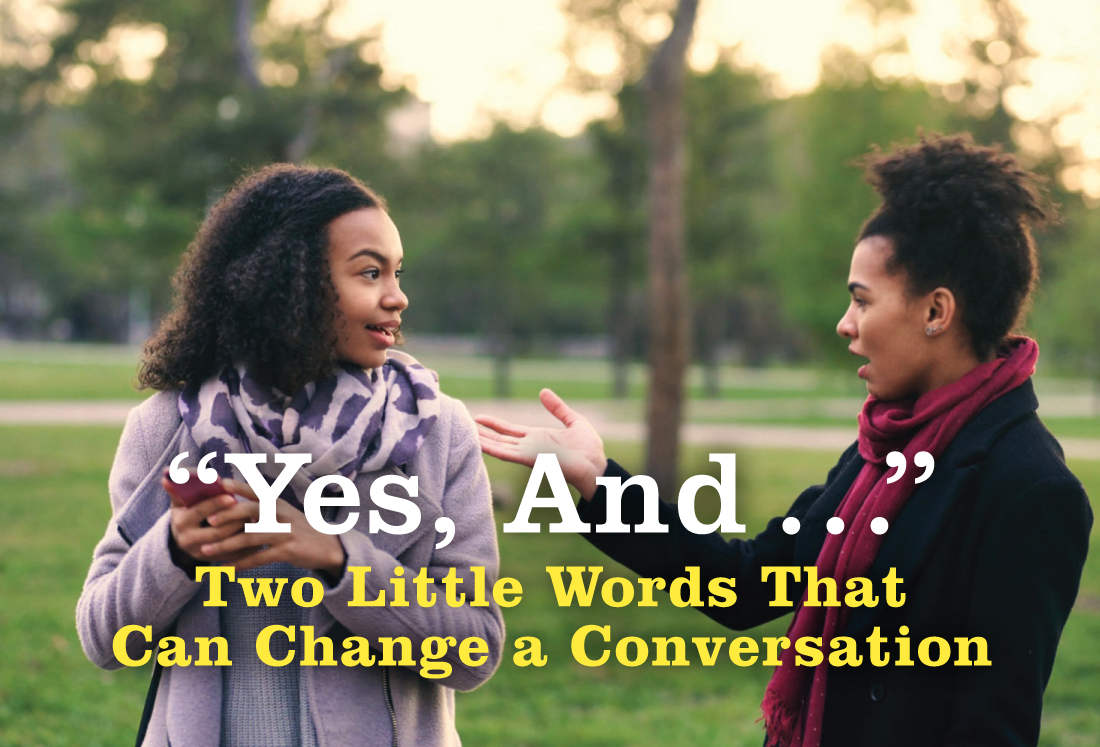
Have you ever shared an idea with someone, only to have them immediately tell you why it won’t work? Or perhaps you’ve been in a conversation where you offer your perspective and hear, “Yes, but . . .” followed by all the reasons your idea, experience, or opinion isn’t quite right. Even when there is no intention to be dismissive, something can happen in that moment.
The conversation closes. We stop listening. We start defending. And sometimes, without realizing it, we stop connecting. There is another way. “Yes, and . . .”
You may have heard this phrase in improvisational theater. Performers use “yes, and . . .” to accept what another person has introduced into a scene and then build upon it. I think “yes, and . . .” has something to teach all of us about how we communicate in everyday life.
“Eventually everything connects—people, ideas, objects. The quality of the connections is the key.” — Charles Eames
“Yes” doesn’t necessarily mean “I agree.” Sometimes “yes” simply means: I hear you. I understand what you’re saying. I can see how you arrived at that perspective. I’m willing to stay in this conversation with you.
Then comes “and.” It gives us permission to add our own perspective without taking theirs away. Consider the different responses between “yes, but . . .” and “yes, and . . .”: “Yes, but I don’t think that’s going to work” versus “yes, I can see what you’re thinking, and I have another idea.” They may ultimately communicate the same disagreement, but they don’t necessarily feel the same.
“But” can create a subtle sense of opposition. It can make what came before it feel as though it has been erased. “And” leaves the door open. It says there is room for your thought, and there is room for mine. That doesn’t mean we have to agree. It means we don’t have to make disagreement the end of the conversation. We don’t have to think alike to connect. This is something I think we could all use a little more of.
“The most basic and powerful way to connect to another person is to listen.”
— Rachel Naomi Remen
We live in a world where opinions can become very personal, very quickly. A difference of opinion can sometimes feel like a difference in values, intelligence, character, or even identity. What if we practiced being curious before being defensive? What if, instead of immediately preparing our response while someone else is talking, we actually listened to understand them? What if we could say “yes, I hear what you’re saying, and here’s how I’m seeing it.” Or “yes, I understand why that matters to you, and here’s what matters to me.” Or simply “yes, I hadn’t thought about it that way, and I’d like to understand more.”
None of these responses require us to abandon our own beliefs. They simply allow us to make room for another human being. Sometimes the hardest part is calming our own mind. And that brings us back to something I talk about often: the busy mind.
We’re constantly processing, interpreting, remembering, predicting, reacting, and preparing. Someone can be three sentences into telling us their perspective, and our mind is already constructing our response. “That’s not what I meant. They don’t understand. I need to explain this. But what about . . .?” Before we know it, we’re no longer listening. We’re waiting for our turn. Sometimes the most powerful thing we can do in a conversation is pause long enough to quiet that internal response and simply become present. Listen. Breathe. Let the other person finish. Then respond. That small pause can change everything.
“Most people do not listen with the intent to understand; they listen with the intent to reply.” — Stephen R. Covey
“Yes, and . . .” doesn’t mean there are no boundaries. Of course, there are situations where we need to say no, opinions we may strongly disagree with, or behaviors we would not accept. There are also conversations where protecting our own boundaries is more important than finding common ground. “Yes, and…” isn’t about becoming agreeable just to keep the peace. It’s about remembering that disagreement doesn’t have to mean disconnection. We can disagree respectfully. We can hold a different opinion. We can say no. We can even walk away, and still recognize the humanity of the person standing on the other side of the conversation.
“It’s easy to judge. It’s more difficult to understand.” — Luigi Pirandello
What if we practiced “yes, and . . .” this week? The next time someone shares an idea that is different from yours, notice your first reaction. Do you immediately want to correct them? Defend yourself? Explain why they’re wrong? Or can you pause? Take a breath. Listen. Then try this: “Yes, I hear you, and . . .” You may discover that something shifts. Maybe they listen more closely to you because they felt heard by you. Maybe the conversation becomes less about winning and more about understanding. Maybe you discover that you actually agree on more than you thought. Or maybe you still completely disagree. That’s okay, too. Because the goal isn’t always agreement. The goal is connection. Connection requires space; space for another person’s thoughts. Space for our own. Space to be curious. Space to breathe.
Perhaps better conversations don’t begin with everyone thinking alike. Perhaps they begin when we’re willing to listen long enough to discover what becomes possible when we don’t.